Showing posts with label education deform. Show all posts

Tuesday, September 3, 2013

Education Insanity in New York

Education reform in the United States is insane.

Don't believe me?

Watch this video and try and make sense of what has been going on in New York.


For more on how public education is being destroyed in the United States check out these posts:

Reduced to Numbers

United States: How not to reform education

New York's New Tests

What has Finland not done?

Judging Teachers via test scores

We need more principals like Carol Burris


Monday, October 15, 2012

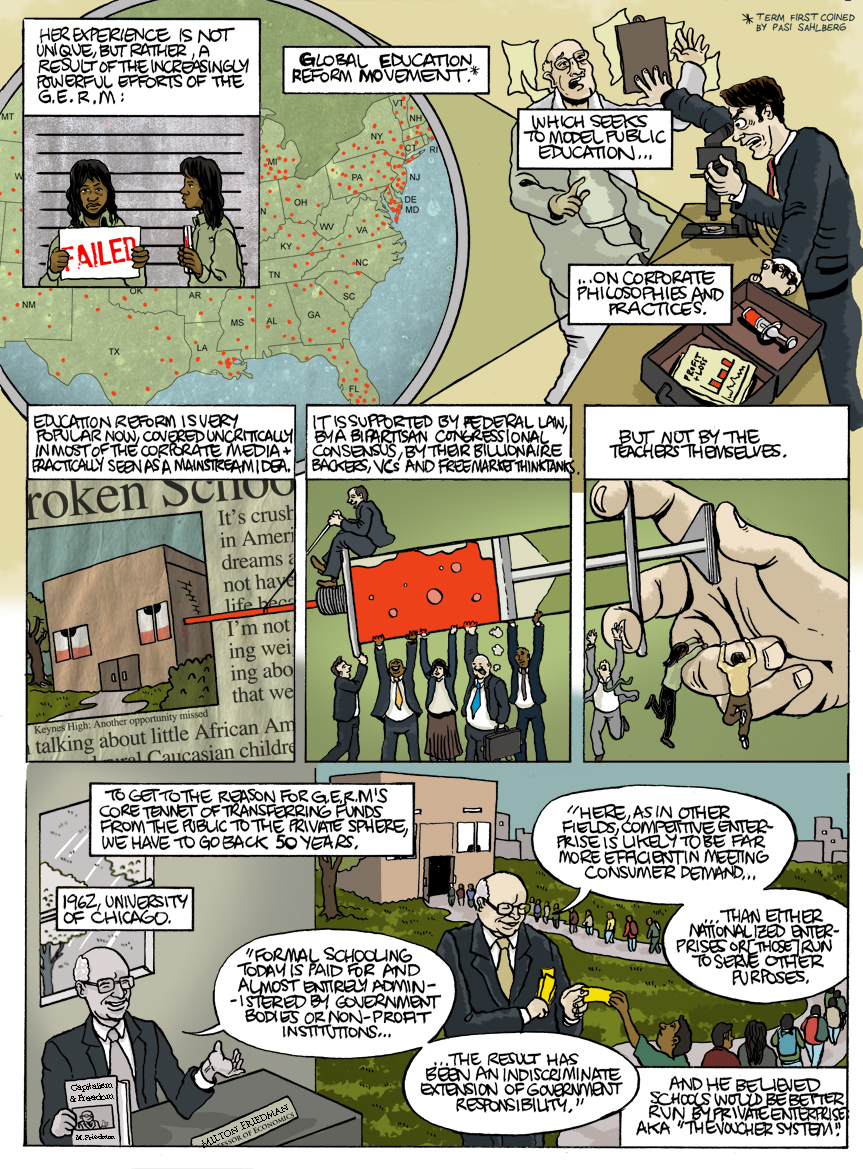
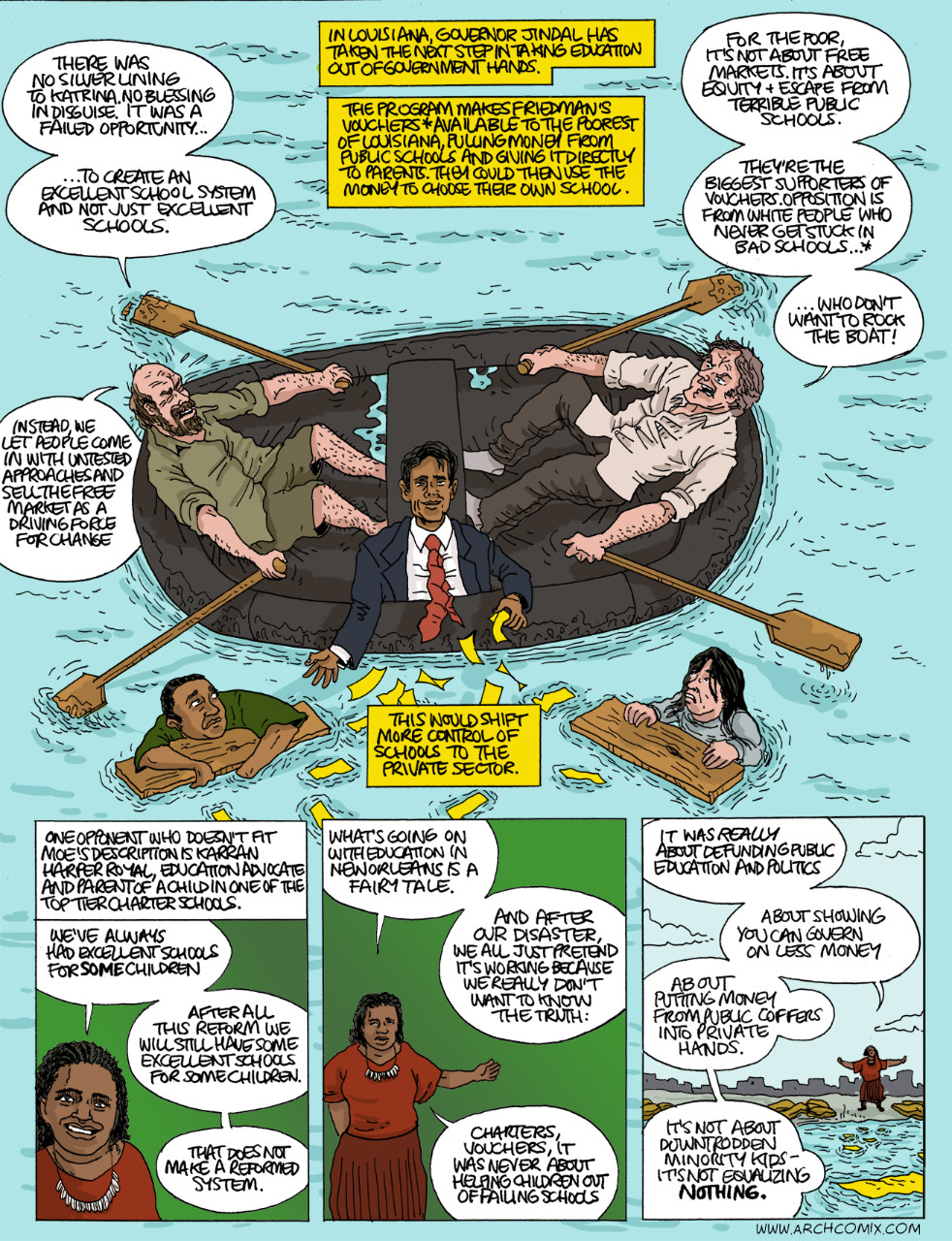
Education Reform as a comic

This was created by Adam Bessie and Dan Archer. The comic first appeared here and here at Truth-Out. The full comic can be seen here.

by Adam Bessie and Dan Archer


Saturday, August 11, 2012

Alfie Kohn on the state of education reform

I was listening to a panel discussion featuring Stephen Downes, Howard Gardner, Alfie Kohn and Gary Stager on Reforming Education Reform.

Here is a portion of what Alfie Kohn had to say about the state of public discourse around education reform:
The discussion that we have about education is only as good as the way that discussion is framed by the people who have ready access to the means of communication. So if public officials and corporate officials and corporate media have framed the conversation in a particular way, then it's likely that we will ask some questions and studiously avoid others. The default assumptions -- the things we take for granted because we've never been invited to reflect on them turns out to be the limits, the barriers, the boundaries to anything we talk about. So for example, if no one invites most people to rethink whether education could be more than just transmitting a set of facts or skills to passive receptacles, then nobody is likely to look around at schools and say, "how come they are still characterized by worksheets, lectures, quizzes, tests, grades and homework just as they were twenty years ago and fifty years ago." Because we think that is how school has to be. 
And if nobody has said standardized tests tend to measure what matters least and there are more meaningful and less destructive ways to assess individual students as well as whole schools then the public discussion will just be based on a sort of monosyllabic  grunting of "test scores go up that's good", and if the larger public conversation assumes that government is always a bad thing and the free market delivers results then we will be inherently suspicious about the great democratic institution of education in this country and we will look for ways to undermine its public status or be receptive to people who attempt to do that. Which is exactly what we are seeing now in the name of choice. 

Saturday, May 12, 2012

Jeb Bush and Global Education Reform Movement (GERM)

Will Richardson shared this video and called it required viewing for every parent and educator who wants a better picture of the global education reform movement (GERM), and I agree.


If I can find the time, effort and patience, I really want to go through this video and offer some line by line critique.

Mike Thayer left this comment on Will Richardson's post. I think it speaks volumes:
The bottom line to me is, this is a talk about tactics; the fundamental strategy of the new educational reform movement is left unsaid.
According to Gov. Bush, the tactics for the new reformers are pretty simple. Tactically, the strategic goals will be achieved if the "reformers" are able to: 
1) Create the perception that "higher, better" standards will help solve the problems of education.
2) Create the perception that (public, only public) schools are failing.
3) Create the perception that there just need to be great teachers in every classroom, and all will be well.
4) Create the perception that technology will be the panacea. 
Here's the great part: For no particularly good reason, I actually believe that Gov. Bush believes each of these (that is, remove the words "create the perception" from each of the items above). And he has the conviction of the true believer. Anyway... 
The strategic goals are, as far as I can tell: 
1) To privatize education completely, or at least to corporatize it to the point that the contrast between public vs. private/charter/whatever schools would be a distinction without a difference.
2) To treat education as a field that could become a source of major profits for large corporations.
3) To make students who view knowledge as purely pragmatic, rather than providing them with means to be more critical or holistic thinkers. Having future consumers with a very simplified view of the world is good for business.
4) Etc. 
I think if we care about the ideal of truly public education, we need to develop strategies and tactics of our own. We are way behind the other side on this one, in my view.
I would also add Alfie Kohn's article Beware of School "Reformers" as required reading. With chilling accuracy, Kohn identifies the ingredients to be a school "reformer":
* a heavy reliance on fill-in-the-bubble standardized tests to evaluate students and schools, generally in place of more authentic forms of assessment; 
* the imposition of prescriptive, top-down teaching standards and curriculum mandates; 
* a disproportionate emphasis on rote learning—memorizing facts and practicing skills—particularly for poor kids; 
* a behaviorist model of motivation in which rewards (notably money) and punishments are used on teachers and students to compel compliance or raise test scores; 
* a corporate sensibility and an economic rationale for schooling, the point being to prepare children to “compete” as future employees; and 
* charter schools, many of which are run by for-profit companies.

Friday, February 24, 2012

The American Contradiction


In the United States corporate reformers, also known as educational deformers, have created an American Contradiction:

Use PISA scores to show that public education in the United States is failing but then implement market-based reforms that are almost entirely contradictory to the reforms and policies found in high achieving countries.
 For more on this American Contradiction, I suggest you take a look at Marc Tucker's Standing on the Shoulders of Giants.


NOTE: After reading John Spencer's comment on this post, I changed this post from "the American Paradox" to "the American Contradiction". I agree with John, it better describes what is going on.

Monday, November 28, 2011

United States: How not to reform education

While it's true that modelling is important, keep in mind that sometimes we learn as much from the negative exemplars as we do from the positive ones.

When it comes to education reform, there are a lot of different models to look at. Here in Alberta, our education system is doing very well, we have an appreciation for resisting the urge to rest on previous successes.

Alberta's former Education Minister Dave Hancock put it this way:
In Alberta we can be proud that we have one of the finest education systems in the world.  This is a testament to the dedication of our teachers, administrators, school board staff and other educational specialists and professionals who are committed to doing the best they can every day. 
But we know that the world is changing, and that education must change with it to prepare students for a future none of us can predict.  And the change is well underway.
In their article Testing, Testing, Larry Booi and J.C. Couture make the case for why Alberta has a lot to learn from the Finnish model of education. Meanwhile, they also make a point that Alberta has a lot to learn from the United States which acts an an anti-model. In other words, the United States has a lot to teach the world about how not to reform education.
By contrast we can also learn what not to do from reform in the US, whose education system is in decline. Its elements, implemented over the past two decades, are largely ideological: "market-based" reforms (the application of "business insights" to the running of schools); an emphasis on standardization and narrowing of curriculum; extensive use of external standardized assessment; fostering choice and competition among schools, often with school vouchers; making judgements based on test data and closing "failing schools"; encouraging the growth of charter schools (which don't have teacher unions); "merit pay" and other incentives; faith that "technologically mediated instruction" will reduce costs; an overwhelming "top-down" approach which tells everyone what to do and holds them accountable for doing it.  
President Obama's education policies have largely reinforced this overall approach, to the great dissapointment of many educators. US Secretary of Education Arne Duncan has pushed states to include merit pay, charter schools and standardized testing in order to qualify for federal funding in the key "Race for the Top" program (soon dubbed "Race to the Bottom" by critics). These directions are popular with large corporate interests, notably educational publishing companies. K-12 education in the US presents an estimated trillion dollars in opportunities for potential privatization.
When I read about the education deforms that are taking place in the United States, I take careful notes so that when I play my role in transformational change in Alberta, I will be prepared to do the exact opposite.

All this makes me extremely thankful that Alberta has leadership in both Alberta Education and the Alberta Teachers' Association who understand that while the Americans may be our neighbours geographically, they are pedagogical strangers.

Friday, November 25, 2011

Anger is the enemy of instruction


When I watch this commercial, I see the the mad chef as the corporate reformers who wish to control what goes on in the classroom from outside of the classroom by publicly shaming and manipulating teachers.

Phil Jackson represents the educators whose collective knowledge and experience routinely go unrecognized.

The sad irony is that no high performing country has ever become high performing by pursuing strategies that villainize teachers.

In the context of this commercial, Phil Jackson has nothing to gain from confronting the mad chef, and so he smartly just walks away. For a long time, teachers have put up with what I call "initiativitis" which is an acute condition educators experience when flavour of the month proclamations come from education departments on Mount Olympus. In response to these popcorn initiatives, some of the best teachers have simply retreated to their rooms, closed their doors so they could do what they do best -- teach their children.

Because corporate suits have upped the ante, passive defiance will no longer suffice. All it takes for ignorant policies to prevail is for good teachers to say nothing. If teachers are not willing to stand up and refuse their cooperation in an effort to reclaim their profession, no one else will do it for them.

Not even the Zen Master.


Saturday, October 29, 2011

This school almost made me cry

I came across an interesting blog today called Autodizactic.

The post that grabbed my attention is titled This school almost made me cry:
The students are lined up outside the school doors. In matching navy blue sweat suits, sleepiness hangs over them like a morning haze. I attribute their silence to the same tiredness I remember my own students wearing as they entered my eighth grade classroom.
The door to the school opens and the flood of students I remember witnessing as a teacher and experiencing as a student doesn’t happen. The students remain in a single-file line. The groggy morning murmurs have ceased. The line has moved from quiet to silent. Just over the threshold, the principal meets each student and asks them to lift their pant legs so she can see their socks. The few students wearing blue jeans are asked to lift their shirts so the principal can see their belts. 
The students file down the hall - still silent - and sit in “community circle” and wait to be dismissed to their classrooms. The teacher overseeing community circle this morning is the only voice to be heard in the room, “I’m sorry eighth grade. Seventh grade is so quiet, I’m going to have to dismiss them first.” 
Without a word, the seventh graders gather their backpacks and lunch boxes and file past me back down the hallway. One of my host teachers says, “Don’t be surprised when they don’t speak to your or acknowledge your presence. They’re on silent.” If a student were to turn to look at me or say “hello,” she explains, the student would receive a demerit. I later learn the principal’s spot checking of socks and belts also held the potential of demerits. Anything other than plain white socks or jeans without a belt are grounds for a demerit. “They are symbols of status,” the host teacher explains. 
I bite my tongue at this. I am a guest, and it is not my place to point out the school’s treatment of its students is a constant reminder of status.
The last paragraph of this post should hit us all like a double-decker bus.

Alfie Kohn puts it this way:
All that is necessary for the triumph of damaging educational policies is that good educators keep silent.


Friday, October 28, 2011

The bane of economic reasoning

When we allow education to be driven by the same economists who were the architects of the 2008 economic collapse then we shouldn't be surprised when we get what we pay for.

Education reform that is dominated by economists, rather than educators, will forever be plagued by the bane of economic reasoning:

Overvalue whatever can be quantified and undervalue what cannot.


Wednesday, September 28, 2011

Send us your winners

When school is bastardized as nothing more than make test scores go up, don't be surprised if schools give you high scores in ways that alienate and marginalize the very students who need school the most.

When accountability is simply code for punish low scores, don't be surprised when private schools and charters build their mission around send us your winners and we'll make winners out of them.


Tuesday, June 7, 2011

Education deform is dehumanizing

A better rule book with better rule-followers won't make anything better.

A better curriculum with better tests will never make schools better.

Education deform is built around dehumanizing the education system by propping up content-bloated, prefabricated, highly prescribed curriculums that are married to punitive, high stakes standardized tests that are quickly followed by the reinforcements. We are all choking on carrots or sore from sticks - either way, most of us are either too drunk on incentives or scared shitless to stand up and question school deformers.

Those who present a healthy dose of skepticism about what is generally taken on faith as the best way to improve schools (read: prescribed curriculums and standardized tests) are put in their place with the kind of efficiency that would make the likes of Benito Mussolini proud.

I don't have all the answers for authentic education reform, but I do know this: getting all teachers and all students to simply teach and learn the curriculum so that they can achieve high test scores won't improve a damn thing. To think otherwise reminds me of an old saying: "For every problem there is a solution that is simple, elegant and wrong." Good teaching and real learning are far too complex for what a silly, over-simplified solution such as standardization can offer.

A teacher who teaches curriculum well with students who test out proficient can no more call themselves teachers and learners than someone who simply follows a trail can call themselves an outdoorsman.

The sooner we can come to this realization the better because our kids can't wait.