Showing posts with label class size. Show all posts

Thursday, June 4, 2015

MYTH: Class size doesn't matter

This was written by J-C Couture who is the Alberta Teachers' Association's associate co-ordinator of research. This post was originally found here.

Jose da Costa
by J-C Couture

Few other public policy questions have been more contested in the past couple of decades than that of class size. While there has been a large body of scholarship internationally on this issue, anyone familiar with the rich legacy of educational research in Alberta will point to the 2001 study Literacy Achievement in Small Grade 1 Classes in High-Poverty Environments, co-ordinated by Fern Snart, then associate dean of the faculty of education at the University of Alberta, and co-researchers Margaret Haughey and José da Costa.

Working with Edmonton Public Schools staff, the research team examined improvements in student learning when classes were limited to 15 students, and participating teachers were supported by professional development activities focused on balanced literacy and/or early literacy.

To acknowledge and draw on this legacy of important study, I interviewed José da Costa, currently a professor of educational administration and leadership at the University of Alberta. While the study was conducted close to 15 years ago, it has stood the test of time and reinforced subsequent national and international studies that clearly demonstrate that class size reductions augmented with supports for high quality teaching do in fact make significant improvements in student learning.

Q. In 2001 you were part of a landmark study on class size in the Alberta context. One of your key findings was that “reduction in class size produced various benefits, many of which have been previously recognized by researchers — less noise, fewer overt discipline issues, more space and hence a greater sense of ­autonomy, and sufficient ­resources. These benefits resulted in better learning, improved student interaction and positive social growth.” Can you tell us more about some of these key findings?

A. Our main finding showed that teachers with smaller class sizes had more time to devote to each child, to support and scaffold their learning more effectively. These characteristics you provide above were critical for teachers to create and focus on learning in their classrooms.

Interestingly, this didn’t just happen automatically as a result of reducing class size, which happened just after the Christmas break in the middle of the school year. It came about in the second year of the project after teachers had engaged in a variety of the professional development experiences, including coming together once a month to discuss their practices and reflect on insights from the research literature. This was facilitated by Fern Snart, Margaret Haughey and me as part of the research project.

In the first year of the project, during the first six months, teachers treated their small classes, which had literally been cut in half — taking classes of 26 to 32 and making them 13 to 16 students in size — as though they still had the larger groups. The teachers didn’t work differently with students in that initial phase. They simply were not familiar with practices for teaching these smaller groups differently from the approaches they had used for years with the large groups.

As with other education policy changes, the reduction in class size came about as a surprise, with most teachers not finding out about the change until the very beginning of January when they arrived at school. Furthermore, new teachers had to be hired to teach the additional classes that had been created. They had days to plan how they were going to teach their classes over the following six months. The teaching staff had almost no direct experience teaching groups of 13 to 16. Teachers felt they had to turn on a dime and reconsider familiar practices that worked in large classes but were not optimal for addressing the needs of all students.

In the second year of the project, however, teachers talked about changing their instructional practices as well as re-imagining learning experiences for the smaller groups of students they were teaching. They spoke of having far more time to devote to each learner to address questions and to provide formative feedback to support their learning. Many teachers shared stories of being able to identify students who performed adequately, but not to the best of their abilities. These students they then supported much more actively to “push” them to the extent of their abilities.

The teachers talked about, in very real terms, what we now commonly refer to as differentiated instruction. Without the significant reductions in class size, teachers were not able to meaningfully develop and support individual program plans. I recall one teacher who realized, with the switch to the substantially smaller class, that one student who appeared to be progressing with the class was in fact falling behind but was skilfully masking this by asking her classmates for help and borrowing other students’ work. This sort of falling through the cracks happens when we expect teachers to work with large numbers of students with complex learning needs.

Q. Your team’s study made an important contribution to the public policy discussion back then. Since that time there has been a lot more research and of course much more controversy and contestation. Looking back on the past decade, how if at all has your thinking changed on the class size issue?

A. I think where we saw the greatest shift as a result of our work and the work of many other researchers looking at the class size issue was in the recognition of the importance of smaller class sizes in the critical formative years in lower elementary school. This seems to be the time during which students develop their efficacy as learners. Even today, the per-student grant for students in the lower elementary grades is still considerably higher than the grants for upper elementary and junior high school. (High school is funded on a credit equivalent unit model that actually encourages large class sizes.)

If we’re serious about having students learn curriculum in ways that are meaningful to them and in ways that positively impact their communities, we can’t just herd them through a factory funding and mass-production model, allowing them to sort themselves. Every child who we fail to support to reach his or her maximum ability is a loss for our local communities and society as a whole. What is the loss to society when, because of excessive numbers in a classroom, a student gains only the knowledge required to get a good grade but fails to gain mastery that would allow deeper understanding of a subject at advanced levels of learning?

What have we gained as a society in the long term by saving education dollars by putting 35 students in a class when the child who had the aptitude and ability to be successful doesn’t learn in elementary and junior high school the nuances necessary for this success? If the government wants to increase class size because of its own fiscal priorities, then it must be clear with the public about the consequences — that scarce resources must be allocated and troublesome choices will be made that are not in the best interests of students.

Q. As you know, many pundits and policy-makers, citing international studies including those emanating from the Organisation for Economic Co-operation and Development, claim that the Alberta government should focus on quality teaching instead of class size reductions. Do you see merit in these claims?

A. The balance between quality of education and the number of learners in a classroom being taught by each teacher is one that seems to come up whenever governments are looking for a place to reduce expenditures. The education system we currently see in our publicly funded schools is the product of the Industrial Revolution, when an efficient mass production approach to education was put into place. The system then was meant to enable students to gain a sufficient but rudimentary understanding of reading, writing and arithmetic so they could be productive factory employees. These rudimentary skills are a far cry from our expectations of learners today.

Today’s classrooms cannot simply be places in which teachers, as talking heads, deliver their lessons and then have students regurgitate what they heard on meaningless worksheets. Today’s classrooms must be focused on individualizing instruction to facilitate meaningful learning, starting with what the learner knows and understands and what is meaningful — it’s about creating learner-centred experiences rather than teacher-centred experiences.

We also need to recognize the great diversity of our learners. These include abilities such as intellectual capacity and cultural and linguistic diversity. The diverse learning needs in our classrooms are accentuated by mainstreaming initiatives that have seen the desegregation of students with learning disabilities. This is a move in the right direction for learners, but this shift does place additional demands on classroom teachers to meet the learning needs of an even more diverse group of learners than ever before.

Of course quality teaching is critical. However, increasing class size beyond what the literature suggests as optimal — somewhere between 12 and 17 for the lower elementary grades and about 20 to 25 in upper grades — simply results in teacher time being spread more thinly across the increased number of learners. This simply results in a system in which students are seen to be learning as long as they meet whatever external benchmarks have been established. This takes away the focus from enabling students to learn and achieve to the best of their ability.

For example, the student who consistently achieves the standard of excellence on external tests but isn’t actually pushing herself to do so is achieving below her capability. Teachers don’t have the time, in large classrooms, to push that student to reach her individual capacity. If we fail to do this, we fail the student and our province’s future.

Q. As a researcher, you have seen decades of debate on class size in this province. How might we engage education partners and the public at large in a meaningful discussion around the class size issue?

A. This is a very difficult question. I think it is more a political question than a research one, although research can obviously inform the discussion.

Parents who see their children in classes with large numbers of other students with diverse learning needs are often the ones who notice their children aren’t getting pushed to the limits of their ability. Those parents who have the social capital and financial ability often enrich their children’s learning by providing them with enrichment activities outside of school.

Members of the general public who don’t have direct connections to contemporary schools are less likely to be sympathetic to the learning needs of students in large classes, or of students in smaller classes that have unprecedented numbers of children with a variety of individualized learning needs.

We can only understand schools from the point of view of our experiences with schools. People who are not directly connected to K–12 schools typically view the education system based on their own experiences as a learner in that system, even if that dates back four, five, six or more decades. While schools and education have changed drastically, even in the last couple of decades, our experiences are always grounded in what we know and what we think is still true. I believe the issue is, how do we challenge those preconceptions to the point where people understand that today’s classrooms are not what they experienced decades ago?

I think it would be useful for the profession to raise public awareness of what teaching and learning are about in 2015 and what we anticipate these being in the next decade or two. I don’t mean conducting surveys in which teachers tell everyone how busy they are. The public doesn’t want to hear that and, frankly, it just comes across as whining.

I think the public needs to see what educators are working toward in our publicly funded schools and what that looks like. We need to capitalize on the power of story. The public needs to see, not just hear, that how and what our children are learning in K–12 enables them to contribute meaningfully to society and will have a direct benefit for individual taxpayers. Let’s keep in mind that these are the people who support governments and who governments listen to.

That child who isn’t able to become an outstanding tradesperson, cancer researcher, engineer or teacher because we simply allowed her or him to “be good enough” is a loss to us all.

This kind of awareness campaign would serve the purpose of educating the public as to what contemporary classrooms are like and how increasing class size can only have a detrimental effect on the quality of learning experienced in our classrooms, which bears directly on the quality of life for members of society as they age. Once this groundwork has been laid, then I think we will be able to engage in meaningful dialogue and debate about how best to achieve the goals of education.

Wednesday, March 25, 2015

Alberta Education's misleading class size averages

Alberta Education quietly updated their class size average data for the 2014-2015 school year.

In my school district, Alberta Education reports that there should be 24.1 students in my grade 6 classes, and 25.2 students in my grade 8 classes.

Because I live in the real world, I feel compelled to share with you that these average class sizes do not accurately reflect my students' reality.

I teach two grade 6 classes language arts and social studies. I also teach two grade 8 classes social studies.

I have 32 students in every single one of my classes.

Both of my grade 6 classes have 7.9 more students than Alberta Education reports.

Both of my grade 8 classes have 6.8 more students than Alberta Education reports.

I teach 29.4 more students every single day than Alberta Education reports. To be clear, that's more students than what Alberta Education reports are in any one of my classes.

Real accountability is about providing the public with the information they need about their public schools. Public assurance is about transparency, but there is nothing transparent about these average class sizes reported by Alberta Education. This Alberta Education class size report conceals more than it reveals. I wonder who benefits from this misleading information?

Class size and class composition matter because they have a huge affect on students' learning conditions and teachers' working conditions.

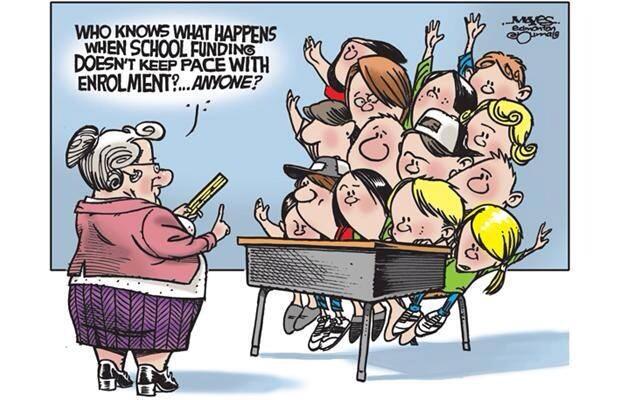
In 2013, the PCs cut 14.5 million from School Boards, but 11,000 new students enrolled. Today, a 9% cut is projected which could cut 2,500 teachers while 19,000 new students enrol.

Since 2008, Alberta's K-12 student population has grown by more than 70,000 students.

Unstable and inadequate government funding has meant that the number of teachers has not kept up with the surge in student numbers.

A five percent cut in funding next year could mean the loss of an additional 2,500 teaching positions at a time when another 19,000 students are likely to be added.

Check out this telling infographic that asks: Who Will Teach Us?

Tuesday, January 6, 2015

3 big ideas about teacher workload

Andrea Sands wrote a great piece in the Edmonton Journal about Alberta teachers who are taking part in a massive workload study. (I've written about teacher workload here).

As a classroom teacher, I have 15 years of experience actually teaching in public schools. I don't just write and talk about teaching -- I'm actually teaching. I don't just have something to say, I'm doing the work and I have something to say about it.

During my interview with Andrea, I tried to emphasize that it is not simply the quantity of my work that is problematic -- the problems I face in my classroom can be best found in the complexity of teaching. Simply put, I am expected to teach too many children who have too many needs.

Let me explain.

This is my 15th year of teaching.

I've mostly taught middle school, but I've also taught some special education.

At home, I am a father where I have a class size of two: Kayley is 7 and Sawyer is 2. While Kayley wants to play a farming board game where we plant, harvest and sell crops for cash that involves adding and multiplying, Sawyer wants to run around and throw the game pieces. You can imagine how different their needs are.

At school, I teach 126 students every day. I have thirty-three grade 6 students that I teach language arts and social studies, and thirty-three grade 8 students that I teach social studies. I see the grade 6s twice a day and the grade 8s once a day. Each class is forty-nine minutes.

At home I get pulled in 2 different directions while at school there are over 30 different students every 49 minutes, 6 times a day.

To be clear, these are not 126 similar children.

Some of these children:
  • are living in poverty
  • are abused and neglected
  • have Fetal Alcohol Syndrome
  • are reluctant learners
  • are learning English as a second language
  • are behaviourally challenged
  • suffer from mental health issues
  • come to school a couple times a month, or not at all
  • are academically challenged
  • are immature
  • are not loved
  • are uninspired
And yet some of these children:
  • love school
  • love to read
  • are loved
  • are curious
  • are inspired
  • attend regularly
Too many of my students draw from the first list -- not enough are described by the second. While all of my students are in middle school, some would fit well in elementary and some are ready for high school.

Individually, I feel confident and competent working with children from either list, but when faced with 30+ every class and 126 of them everyday, I am overwhelmed. 

Here are 3 big ideas I would like people to understand about teacher workload:

1. I meet all my students' needs only if some children don't show up. Many Albertans work hard, and some may work more hours in a week than teachers. My issue is not that I average 45 to 50 hours a week. My issue is that I'm expected to teach too many students with too many needs. My expectations for my students are only surpassed by the expectations I have for myself. Everyday I go to work hoping to get to every child only to go home knowing that I can't. Alberta parents should be upset about this as much as Alberta teachers are.

2. My working conditions are my students' learning conditions. Too many people want to frame this teacher workload discussion around how much teachers get paid and how much time they get off. I'm not asking for more pay or time off, although these are important, I am saying that because of the current deteriorating conditions in Alberta schools, quality and quantity of student learning is suffering. When we play politics with education by framing this as a labour debate (instead of an education debate), children lose. 

3. Teachers are so busy teaching they don't have time and effort to learn how to be better teachers. School has looked, tasted, smelled and felt like school for too long. In order for things to improve, things have to change, and sustainable change needs to be led by teachers who are supported through inspiring professional development. I know too many teachers who are so overwhelmed by their teaching assignment that they don't have the time or effort to learn how to change and improve their teaching.

In our cars, we have instruments that tell us when our fuel is low and engine temperature is high. 

In education, we have teachers who have their fingers on the pulse of their classrooms.

We ignore our car's instruments and teachers at our own peril. It should be no surprise that those who are comfortable with the way things are become angered by those who wish to influence change. Labelling these gauges as whiny allows us to criticize, distort or dismiss inconvenient information in favour of our existing beliefs while ensuring that things get worse for our children.

Monday, May 5, 2014

9 ways Jeff Johnson and his task force have failed Albertans


Dear Jim Prentice,

As you may know, there is a rumour going about that you may be interested in the leadership of Alberta's Progressive Conservatives.

While I'm sure there are a gazillion reasons why you should not pursue political suicide, here are 9 more that are specific to Jeff Johnson and his task force on teaching.

Johnson is reckless


Too often, Johnson tries to make change by imposing his will on those who have less power. First, he threw around the idea of merit pay (the bad idea that won't die).

He threatened to remove teachers' collective bargaining rights with legislation. Using the teachers' registrar certification contact list, he sent an e-mail to 30,000 teachers, and now is being investigated by the privacy commissioner.

He orchestrated an agreement with Alberta Teachers without including School Boards.

And now Johnson thinks that he can improve Alberta schools with his Orwellian Task Force that looks to take over punishing teachers. The Alberta Teachers' Association is raising serious concerns about direct ministerial interference in the work of the task force and have requested a FOIP request on Johnson's Task Force.

Johnson ignores teachers


The best decisions for the child are made by the child in collaboration with a safe and caring adult who actually spends time with them. Those adults are not bureaucrats or politicians -- they are the classroom teachers. Jeff Johnson continues to openly ignore teachers and their Alberta Teachers' Association. 

To create a task force on teacher excellence without actively collaborating with teachers is contrary to common sense, collaboration and transparency. 

There is a big difference between keeping teachers passively informed and encouraging them to actively participate in improving Alberta's schools.

Johnson confuses innovation with privatization


When asked about for-profit, online charter schools, Johnson says he's open to all options that create excellence and opportunities -- despite the evidence that for-profit, online charters offer children neither excellence or opportunities. 

Being open-minded is one thing but Johnson's response is growing old and tired. Every time someone asks him about a potential idea in education, regardless of its quality, he fires back with this hollow political boilerplate.

Albertans should be immensely proud of our world-class public education system -- simultaneously, Albertans should be appalled when our elected officials consider for-profit, private schools as a way of improving our education system. I've written a post here about why Cyber Charter schools are such a bad idea. 

It's one thing to suggest that students should be encouraged to become entrepreneurial but it is quite another to unleash entrepreneurs to profit off of children and public education. To be clear, this is not about pedagogy -- it's about privatizing public education which is ultimately wrong.

Johnson is entitled


After Alison Redford's gross misuse of taxpayer's dollars, The Alberta Party brought to light Jeff Johnson's entitlement: "Education minister Jeff Johnson’s expenses reveal double-billing, lost receipts, taxpayers billed for optional extras like seat selection and hotel movies, and include a backdated claim for an expensive hotel room during the Calgary Stampede."

Johnson votes against Gay-Straight Alliances that put children first


Johnson will wear a pink shirt on anti-bullying day, but he won't vote for legislation to help kids. 


This is yet another example where Johnson's walk lies in stark contrast to his talk of putting children first. 

Johnson says class size doesn't matter


If I was Jeff Johnson and the Alberta Government, I may want to distract the public from funding cuts in public education by creating a task force that focuses on teacher quality. For this school year, the Alberta Government cut school board budgets by $14.5 million even though 11,000 new students entered Alberta's schools.

This will lead to all sorts of problems for teachers' working conditions including larger class sizes. While it's true that reducing class sizes is not a sufficient move to improve an education system, it most certainly is necessary. Alberta Teachers' Association President Mark Ramsankar describes the problem aptly when he said, "a Ferrari still can't perform on a gravel road." Check out this video on the inequities in Calgary's schools.

A great teacher with 15-25 students in the classroom may be a mediocre or even poor teacher with 30+ students. When the government doesn't do their job of properly funding and supporting teachers, it makes it harder for teachers to do their job.

Ultimately, great teachers make great schools, but great teachers can’t do it alone – they require the support of an equitable society.

Johnson and Big Oil


Suncor, Syncrude, Cenovus and other big oil corporations are enlisted by Johnson as partners in the current curriculum development. Other tech companies such as Apple, Microsoft, Pearson and SMART have also been signed up. 


Johnson wants to punish teachers

Are there some bad teachers in Alberta?

You bet there are, but there are also bad accountants, doctors, mechanics, columnists and politicians.

There are incompetent professionals in all professions.

The most successful education nations don't test and punish their teachers -- they diagnose and support them. The best education systems in the world worry less about firing bad teachers, and more about creating and supporting great teachers.

We don't have a teacher quality problem -- we treat them so badly, they leave.

The Alberta Teachers' Association's Research tells us that one of the major causes of early-career teacher attrition is inadequate pre-service preparation (which traditionally has been a greater concern in the US than in Canada) and difficult working conditions (particularly in under resourced schools) and professional isolation.

Alberta doesn't have a teacher quality problem -- we have a teacher leakage problem. Because of systemic problems, anywhere between 25-50% of teachers leave inside of before five years on the job.

Johnson's Orwellian Teacher Task Force will kill Inspiring Education


Jeff Johnson needs to stop borrowing America's
failed Education Reforms.
Johnson's Inspiring Education is about control and compliance via mistrust, manipulation and competition. Johnson sees himself as the change agent that will disrupt the system. Rather than work with teachers, he merely does things to them.

He uses Inspiring Education and his Excellence in Teaching Task Force to create the impression that he is collaborating while he pursues his political agenda.

Rather than address the growing inequities students are experiencing as a result of his government's broken promises (poverty reduction, full day kindergarten) he trots out the Task Force for Teaching Excellence and continues to distract public attention away from classrooms that are growing in size and complexity by cherry-picking data from international studies, claiming that class size does not matter and chasing American-style market based reforms such as merit pay.

***

As you know, Mr. Prentice, the PCs in 2014 have no shortage of enemies, and adding teachers to the list makes as much sense as running for the leadership.

Friday, March 7, 2014

Who will teach Alberta's new students?

When it comes to school based accountability, we hand out microscopes for test scores and blindfolds for funding inputs and social inequities.

Alberta's Budget was released yesterday. Read about how the Budget fails to protect classrooms.


Friday, February 7, 2014

Does size matter?

This was written by John Scammell who taught high school math for 18 years before becoming a high school math consultant. He blogs here and tweets here. This post was originally found here.

by John Scammell

Defining my terms:

A columnist is someone who writes for publication in a series, creating an article that usually offers commentary and opinions.

A journalist collects, writes, and distributes news and other information, while refraining from bias.

An Edmonton Journal columnist, one who could never be accused of even partially refraining from bias, has been arguing that class size reduction efforts in Alberta have been a waste of money. He cites research and even quotes the head of PISA(sounding dangerously like a journalist), but then conveniently leaves out relevant details that would contradict his argument (he is, after all, a columnist).

Some high performing countries (according to PISA) have larger class sizes than we do. The obvious conclusion is that we should increase class sizes, right? Not so fast, Mr. Biased Columnist. It’s only a logical conclusion if you ignore other all the other factors at play.

Currently, the norm in high schools in Alberta is to have teachers teach 7 out of 8 blocks. That means each semester I see four unique classes of around 35 students, for a total of 140 students per semester. I get an 80 minute preparation period every other day. Because of the already large class sizes, I spend most of my preparation time creating and grading assessments. Very little of my preparation time is spent on actually thinking about how to teach my material better.

Mr. Biased Columnist points out that places like Finland, Korea, Singapore (among others) have class sizes that are larger than in Alberta, and still perform better on PISA (this is fact). What he deliberately neglects to tell us (Logical fallacy of Omission – Stacking the Deck) though, is that teachers in those countries spend far less time in front of students than we do in North America. From the Singapore Ministry of Education:
The workload of our teachers varies across the year, depending on whether it is peak or non-peak periods. Over the entire year, our teachers teach, on average, about 15 hours per week. To deliver classroom teaching effectively, teachers also spend approximately twice as much time on teaching-related duties such as preparing for lessons, providing remediation for weaker students, setting and marking of homework and examinations.
They spend double their assigned time on teaching related duties compared to time spent teaching. I spend 1/8 of my assigned time on teaching related duties compared to time spent teaching.

Singapore has secondary classes in the neighbourhood of 40 students, but based on what I read above, they would only see two of those a day. That’s a total of 80 students per semester, which is far fewer than we see each semester in Alberta. In addition, the Ministry of Education in Singapore indicates:

Some schools also deploy two teachers in a class of 40 students—one teacher brings the class through the curriculum, while the other teacher assists specific students who may have difficulty understanding the materials being covered.

Wow! Singapore teachers actually have less marking to do than I do, more time built into their schedules to collaborate with colleagues and plan good lessons, AND they get to team-teach in large classes? It’s a model I’d be willing and eager to explore. Are they hiring in Singapore?

Mr. Biased Columnist suggests that good teachers will do well no matter how many students we give them. I agree. Under our current conditions, however, they will likely burn out from all the marking and management problems that large classes can bring. We don’t want to burn out our good teachers, do we? One third of new teachers in Alberta burn out within 5 years. Let’s revisit Singapore.

The annual resignation rate for teachers has remained low at around 3% over the past five years. In our exit interviews and surveys, workload has not been cited as a major reason for leaving the Education Service. Nonetheless, we will continue to monitor the workload of teachers through internal employee feedback channels to ensure that workload is maintained within reasonable levels.

Singapore has bigger classes, fewer teaching hours, more collaborative time built into their day and retains 97% of their teachers. Does class size matter? Not nearly as much as teacher collaboration built into the school day.

On a completely different vein, I do need to point out that in my travels across Alberta, I already see classrooms that were built to hold 25 students jam-packed with 40 desks. I don’t know how we can physically put more bodies into those classrooms. Are we going to build a bunch of new schools with large lecture theatres?

Some Resources I Used:

Tuesday, September 24, 2013

40 is the new 30. #classsize

This was written by Jonathan Teghtmeyer who is with the Alberta Teachers` Association. Jonathan tweets here. This post first appeared on the Alberta Teachers` Association website.

Classes have started up for the new school year and up is the operative word, as in class sizes are up!

In 2002, if you had 30 students, that was a “large class.” At that time, teachers took labour action to protest, among other things, larger classes. Although teachers reported that their classes were becoming larger and increasingly unmanageable, the provincial government believed otherwise. However, the outcome of the labour dispute included a report from the Alberta Commission on Learning (ACL) that recommended class-size averages of 17 students for K–3, 23 for 4–6, 25 for 7–9 and 27 for 10–12. Teachers felt vindicated that the ACL, an impartial body, had concluded that classes with more than 30 students were too big for optimum learning.

What happened to those recommendations? Today, 40 is the new 30 (I want to thank Twitter user @RyanDunkley for this editorial’s headline). Last year, it was common to see a few classes at the high school level with between 38 and 41 students. That was last year, before the Alberta government cut school board budgets by $14.5 million and before 11,000 new students entered the public education system without any additional money to support them. What’s the story this year? In the first week of school, we’ve already heard about a number of high school classes with more than 40 students, and teachers at all grade levels are reporting classes that are unacceptably large.

The government shifted its class-size-initiative funding to focus on K–3 classes because that’s where smaller classes have the biggest impact, where the population increase is greatest and where school boards aren’t meeting their targets. Has that funding made a difference? Not really if we have parents saying their kids are the lucky ones because their kindergarten class size is only 24.

Alberta Education’s website features a page entitled “Class Size Is Important.” The page of information espouses the value of small classes in “laying a foundation for a positive learning environment for our students.” However, even though school boards are obligated to report annually on class-size averages, the government hasn’t updated its report since 2010/11. That school year, three-quarters of the boards exceeded the targets at the K–3 levels, and we know it’s worse today.

On the first day of school, Education Minister Jeff Johnson said he doesn’t believe we should have problems with class size. He said, somewhat incomprehensibly, “There should be more classroom teachersas a proportion of teachers out there” because “we put as much or moremoney into the base instruction and the class-size initiative.”

The minister’s comments are masterfully crafted talking points designed to hide the reality. More classroom teachers as a proportion of all teachers just means that cuts made in central offices were more severe—the truth is we have fewer teachers, fewer in the classroom and fewer in division offices. As much or more money in base instruction and class-size initiative hides the fact that school board grant cuts elsewhere will affect classroom conditions. Sure, some small grants got increases, but others were cut and the big ones stayed stagnant. At the end of the day, more kids and less money means larger classes.

If the minister believes that class size shouldn’t be a problem, perhaps teachers would do well to educate him on this matter. I suggest that you (and the parents of the students you teach) e-mail your stories about class sizes to Minister Johnson at Education.­Minister@gov.ab.ca.❚

Friday, September 20, 2013

Alberta: 11,000 new kids with 14.5 million less dollars


The Alberta government has cut 14.5 million dollars from the education budget. With the addition of 11,000 new students and an increase of 7% in the ESL population, students will feel the pinch. Visit www.stopthecuts.ca to send a message to the Alberta government.

Glenn Kelly/For Metro
So how do these number translate into real life?

Sharad Gadhia, a grade 10 student at Queen Elizabeth High School in Calgary wrote an email to Alberta's Education Minister Jeff Johnson that explained how being stuck in classes with more than 40 students is impairing learning.

This story was covered by Calgary Metro News: 
Sharad Gadhia, who attends Queen Elizabeth High School, said up until Monday, two weeks after classes began, students in his class had been forced to share desks with the teacher and each other, and sit on stools. He said, even now, a large table has been moved in to accommodate a few kids and instructional time resembles something closer to that seen in a university lecture hall.
Here is Sharad Gadhia's letter to the minister:


The Alberta Teachers' Association knows that class sizes are a major problem that needs to be addressed. After all, a teacher's working conditions are a student's learning conditions -- and while it's true that smaller class sizes alone may not be sufficient in increasing student learning, it is absolutely necessary.

Alberta's burgeoning classrooms are boiling over so intensely that on the same day Edmonton Metro and Calgary Metro ran headlines that have Edmonton and Calgary competing for the most overcrowded classrooms in the province:

Calgary Board of Education high school class sizes among highest in province before cuts

Data reveals EPSB high-school class sizes among highest in province before budget cuts

Here are two videos that the Alberta Teachers' Association has published in order to advocate for teachers and students who are faced with overcrowded classrooms.


Remember, class size doesn't matter unless you're one of too many students or the only teacher, and when people say class size doesn't matter, they are talking about other people's children.

Thursday, June 13, 2013

Class Size and Teacher-Student Interaction

This was written by the Canadian Education Association and is an excerpt from their report Reducing Class Size: What do we know?

by the Canadian Education Association

The Ontario study reinforced many of the findings of other class size reduction studies with respect to teacher student interaction. Nearly three-quarters of the primary teachersreported that the quality of theirrelationships with students had improved as a result of the smaller classsize, and two-thirdssaid theirstudents were more engaged in learning than before class size reduction. Primary teacherstold the researchers that smaller primary classes gave them more time to help individual students experiencing learning difficulties and allowed them to carry out intensive, focused, teacher-guided activities effectively.

During group learning,the smaller groupingsmade possible by smaller classes enabledthe teacher to be more aware of, and to encourage, each student’s individual participation. Primary teachers noted that they felt better able to monitor children’s activities during work time, compared with larger classes where student behaviour might go unnoticed for a longer period of time. The more spacious classrooms often allowed for a dedicated location where the teacher could interact with one or a few students while the others worked independently on other activities. 

Improvement in student-teacher interaction appeared to contribute to improved classroom behaviour, as well.Teachers reported that students were calmer than in the past, a fact they attributed to easier and more frequent access to adult attention. Over half observed that peer relationships within the classroom improved, probably another benefit of reduced competition for adult attention.

There may also be child safety benefits to smaller classes. For example, in one context where students and teachers were rehearsing a lock-down drill,smaller classes were seen by teachers as important to ensuring a quick emergency response to account for all children. Similarly,teachersfound it easierto keep track of young children leaving the classroom to line up in the hallway to use the washrooms and to supervise students on class excursions outside of the school.

Tuesday, June 11, 2013

Reducing Class Size: What do we know?

This was written by Penny Milton who is the Chief Executive Officer for the Canadian Education Association. This piece is the forward in The Canadian Education Association's report Reducing Class Size: What do we know?

by Penny Milton

Smaller class sizes are an intuitively good idea. Both parents and teachers believe that smaller groups of students allow for more individual attention and result in higher achievement. In addition, teachers believe that smaller class sizes provide for more manageable classes and better relations with parents. After many studies of the impact of class size, and lively debate about their interpretation, a consensus has emerged that class size makes a small but useful improvement to achievement in the early grades. The impact is greater when accompanied by pedagogical change. 

Because of its widespread popularity, reducing class size is a relatively straightforward policy initiative; its implementation, however, is complex because it affects utilization of classrooms, recruitment and allocation of teachers, and grouping of students, and may require the creation of split or combined grades in the primary and junior divisions.

In 2007 and 2008, the Canadian Education Association (CEA), through a contribution agreement with the Ontario Ministry of Education, conducted a study of Ontario’s newly introduced class size reduction policy to provide a portrait of the teaching and learning environment created in smaller classes and to determine the policy’s impacts, both intended and unintended. CEA contracted with a group of researchers from the Ontario Institute for Studies in Education, University of Toronto, to undertake this research on its behalf. The research team reviewed the literature, analyzed statistical data, conducted field research in eight Ontario school districts, and surveyed parents. The final report was approved by the Ontario Ministry of Education in 2009. 

The research will be of interest to school districts and departments/ministries of education in other jurisdictions. Although the study focused on Ontario, we believe that key stakeholder groups across the country will find it valuable. This report enhances our knowledge of policy implementation at the district and school levels, and provides insights into how to maximize the positive impact of class size reduction policies directed at elementary schools. 

We appreciate the participation of the Ontario school districts and parents that took part in the study, and trust that readers will find this report useful and informative.

Monday, June 3, 2013

The Class Size Myths – Which do you believe?

This was written by Dan Haesler who is a teacher, writer, speaker and consultant. Dan blogs here and tweets here. This post was originally found here.

by Dan Haesler

Over the Australian Summer I finally decided to read John Hattie’s Visible Learning for Teachers.

Hattie’s theories on education are backed up by countless research papers and evidence.

In the never-ending quest to improve teaching (and teachers) Hattie is as revered by politicians and system leaders around the world as he is viewed with suspicion by front-line teachers.

His most controversial assertion is that reducing class size is a waste of time and money. His research proves having fewer kids in class has little impact on teaching and learning.

And don’t the politicians love that!

Bigger Classes = Fewer Teachers = Less money needed for education – Take that Gonski!

In Queensland, the state government has moved to remove the maximum class size limit, presumably confident of a Coalition victory in the September Federal Election, given that Shadow Education Spokesman Christopher Pyne is on record as saying that class sizes have little impact on teaching.

But here’s the thing… each of the interventions that Hattie studied, were done so in isolation.

Does reducing class size in and of itself improve teaching? Is it the silver bullet?

Of course not. A crap lesson in front of 40 kids will still be a crap lesson in front of 20. Hattie himself makes the point that looking at class sizes in isolation showed that some teachers didn’t change their methods regardless of the number of kids in front of them.

But when you look at Hattie’s list of interventions that he claims DO have a great impact then things really start to get interesting with regard to class size.

A teacher’s ability to implement any one or all of these interventions is impacted on by the amount of kids they have in front of them. Anyone who says different has no understanding of teaching, or is clinging to this ideology because it’s the theory du jour and is probably helping them climb the international speaking ladder.

So when politicians say that they won’t be supporting a reduction in class size, what they are actually saying is that they do not support the concepts of developing high expectations for each student, providing quality feedback, improving teacher-student relationships, implementing quality vocabulary or comprehension programs. What politicians are saying is “We’re not particularly interested in improving teaching and learning in our schools. It’s just a little bit too expensive.”

This myth of class-size being irrelevant has permeated into the education debate in many countries like the UK and US. Although, interestingly not Finland where the government agreed to reduce class size, and now the average class size is around 20 kids, with science lessons capped at 16. Sixteen!!

I’m not dismissing Hattie’s work out of hand as I agree with every single one of his “High Influence” interventions for improving teaching & learning – it’s just that having smaller class sizes is essential in order to enable teachers to implement these interventions.

You can read more about the mathematics behind effect size here…

Wednesday, March 13, 2013

Cuts to education hurt our kids


Class size doesn't matter unless you're one of too many kids or the only teacher.

When people say class size doesn't matter, they are talking abou other people's children.

There are many impressive reasons to use technology in the classroom, and increasing class sizes is not one of them.

While its true that smaller class sizes alone may not be sufficient in increasing student learning, it is absolutely necessary.


And to make sure that senior administrators, school board trustees, policy makers and politicians remember this, their offices and places of work should be housed inside of schools.

"If a doctor, lawyer, or dentist had 40 people in his office at one time, all of whom had different needs, and some of whom didn't want to be there and were causing trouble, and the doctor, lawyer, or dentist, without assistance, had to treat them all with professional excellence for nine months, then he might have some conception of the classroom teacher's job."

~ Donald Quinn

Thursday, July 5, 2012

Class size doesn't matter...

Class size doesn't matter unless you're one of too many kids or the only teacher. When people say class size doesn't matter, they are talking about other people's children.

Tuesday, May 8, 2012

Teachers eat their young

Teachers eat their young and education systems encourage them to do so.

Too often beginning teachers are assigned too many courses with too many students and provided too little support. As a first year teacher, I was assigned five language arts classes at three different grade levels. Each class had about 30 students which means I was responsible for teaching about 150 students every day. A teacher who is responsible for more than 100 students in a day isn't really teaching anymore -- they're doing crowd control. I also coached the junior boys volleyball team.

If teacher preparation colleges mentored and supported beginning teachers for their first year of teaching, beginning teachers would benefit from further support and the teacher colleges could remain relevant and connected with real classrooms and schools.

Local school boards, education departments, teachers' unions and teacher colleges need to collaborate in an effort to support and nurture beginning teachers.

Some people complain that we have a hard time getting rid of bad teachers. There's likely some truth to this, but it's a red herring. Getting rid of teachers is easy - we do a good job of ensuring that around half of all beginning teachers leave the teaching profession inside their first 5 years. Because there is a world-wide push to turn teachers into standardized testing technicians, it is likely that many of those who leave the teaching profession are very competent people who are unwilling to subject themselves to such soul killing drudgery.

Andy Hargreaves explains:
We know that one of the biggest impact factors on student learning achievement in the schools is the quality of teachers. However, at the moment we have too many demoralized teachers. The recent MetLife survey showed that there are clear levels of teacher dissatisfaction and that satisfaction is declining. We know that an inordinate amount of teachers are leaving teaching very, very early. The modal (most commonly occurring) number of years' experience in teaching, according to the National Staffing Survey is one. We have more teachers with one year of experience than with any number of years of experience, which is a new thing for American education. 
If we went into hospitals and the most commonly occurring number of years of experience for doctors and nurses was one there would be public outrage. Too many schools are looking for young, inexpensive and flexible teachers with little experience and keeping them for a few years and moving them on long before they have reached the peak of their performance. That's a wasted investment. 
We need to look at why teachers are not staying in the profession and one of the major reasons is too much testing. America is really the only country that tests all the children on almost everything, every year. It is the only country in the world that does this and it's not associated with high standards but it is associated with driving teachers out of the profession because their work is excessively prescribed, excessively standardized, constantly interfered with and lacking the judgment and discretion that all professions need.
If we focused on supporting teachers even half as much as we focus on sanctioning them, we might start to see some improvement.

Friday, September 16, 2011

Alberta Education's flip-flop on class size

On August 29th I saw this tweet from Kathy Telfer who is Alberta Education's Communications Director:

17 days ago I followed the link to the Calgary Herald article
that hosted this quote from Sharon Friesen,
but when I try to click the link now , I get a an error message. I wonder why?
You'll notice that the top, right hand corner of the picture above says 17 days ago. This is important because when I clicked on the URL in Kathy's Tweet 17 days ago I was directed to the quote Telfer featured in her tweet. The article was from the Calgary Herald and was titled "Parents fear affects of growing class sizes". The quote that the voice box of Alberta Education Kathy Telfer featured was from Sharon Friesen, an associate professor of education at the University of Calgary. But when I click on this link today, 17 days later, the link is broken. I wonder why...

To say the least, I was disappointed that the voice of Alberta Education was supporting a stance that might strongly suggest that class size doesn't matter. So I replied to Kathy Telfer one day after her original Tweet:


I think my point is pretty clear. I admit that small class sizes is not some magic bullet or panacea that will miraculously fix public education, but based on a plethora of research, clearly smaller class sizes are at the very least necessary, if not sufficient, in achieving increased student learning.

As if I couldn't be disappointed enough in Kathy Telfer or Alberta Education, here was her response:


This was all made that much more interesting when on September 13, Gordon Thomas of the Alberta Teachers' Association wrote a rebuttal to the Calgary Herald's piece on class size titled "A Sizeable Issue: Class Size Matters" where Thomas pointed out:
Although parents, teachers and trustees are concerned larger classes will adversely affect their children’s education, Sharon Friesen, vice-dean of the faculty of education at the University of Calgary, disagrees. The Calgary Herald quotes her as saying: “We’ve spent a lot of money reducing the number of children per classroom, so one of the questions we need to ask is why is the impact so small on reducing class size?”
(....)
Incidentally, Friesen is a board member of the Calgary Science Charter School, where classes are capped at no more than 25 students per teacher throughout the school.
I find it grossly ironic that Sharon Friesen would discount the importance of class size on one hand while maintaining a leadership role in a charter school that limits class sizes to the rather reasonable number of 25.

This reminds me of the old adage -- class size doesn't matter... for other people's children.

So almost two weeks after this whole mess started, I really have only one question for Kathy Telfer and Alberta Education:


I'll let you know if I get a response but if I were you, I wouldn't hold my breath.


Friday, September 9, 2011

Class size matters

"If a doctor, lawyer, or dentist had 40 people in his office at one time, all of whom had different needs, and some of whom didn't want to be there and were causing trouble, and the doctor, lawyer, or dentist, without assistance, had to treat them all with professional excellence for nine months, then he might have some conception of the classroom teacher's job."

~ Donald Quinn

While its true that smaller class sizes alone may not be sufficient in increasing student learning, it is absolutely necessary.

And to make sure that senior administrators, school board trustees, policy makers and politicians remember this, their offices and places of work should be housed inside of schools.

Wednesday, March 9, 2011

Cut testing or learning?

Tough economic times may be undeniable but how we manage our money and prioritize our budgets should very much be up for discussion.

Ask any teacher if class size matters and they'll tell you it makes a huge difference. Ask a parent how they feel about their child's class of 31, and you'll get an earful. Ask the kids, and they'll tell you how much it matters too.

In my 10 years experience teaching mddle school (grades 6-8), I've noticed that a class size of 20-25 is an acceptable number. Every student added over and above 25 feels like three more each, and a class with 30 or more reduces teachers to lecturers and drill sergeants; teaching looks less like teaching and more like management.

And yet, tough economic times seems to be justification for larger class sizes. In the US, Arne Duncan goes so far as to bribe teachers to take on more students:

Duncan also said that states should think selectively about increasing class sizes. The father of two grade-school-age children said he’d rather his kids be in a bigger class with a better teacher than a smaller class with a lousy one. He suggested teachers could get paid extra for getting a bigger class.


It's plain to see that increasing class sizes is being considered by policy makers as a way of saving money, and yet I wonder how the multi-billion dollar standardized testing industry will fair under tighter budgets?

If we really care about kids, tougher economic times would see high stakes testing suffer more than the children in the classroom.