Showing posts with label testing. Show all posts

Wednesday, August 19, 2015

How can parents and teachers help each other?

This post will be featured in Cathy Rubin's The Global Search for Education: Our Top 12 Teacher Blogs.

Here are 4 understandings that help parents and teachers to educate children.

1. Teach the whole-child. Ask any parents what their long-term concerns and goals are for their children, and seldom will you hear about test scores and world rankings. Their concerns are compelling, existential and heartfelt. Parents want their kids to be happy, hard-working, motivated, responsible, honest, empathetic, intelligent, collaborative, creative and courageous. Of course we want our children to grow academically, but we also want them to grow emotionally, socially and physically, and this requires a well-rounded education.

2. Teaching and parenting is about relationships, relationships, relationships. Parents and teachers know that children do not care what you know until they know that you care about them. Good teaching and parenting is less about doing things to children and more about working with them. Because rewards and punishments are by definition manipulative and coercive, they undermine our relationships and therefore need to be tempered or even abandoned. This means teachers would not use token economies or classroom management schemes that treat children like pets and parents wouldn't use time-outs or bribes. 

3. Good parents and teachers are not born -- they are made. Parenting and teaching are the easiest jobs to get wrong and the hardest to get right. Regardless of experience and expertise, we are all human and are subject to impatience and ignorance.  The best parents and teachers don't waste their limited time, effort and resources on blaming and shaming -- instead, they see every problem as an opportunity to teach and learn.

4. Public education is not a private interest for an elite few -- it is a public good for all. Public education, like democracy, is reserved only for those who fight for it. First time parents don't realize how important sleep is until it is taken from them -- the same is true for our public schools.

The only thing that destructive education policies require to thrive is for good people to do nothing. Parents and teachers must work together as stewards for our public schools and demand that public education remain a public good for all. This requires parents and teachers to pay attention as much or more to their public schools as their favourite sports and celebrities.

Thursday, November 29, 2012

Ravitch: How Teachers Unions Lead the Way to Better Schools

Here's an excerpt from an interview with Diane Ravitch on How Teachers Unions Lead the Way to Better Schools:

What do you see as the role of teachers unions in preserving public education?

For many years, there has been an effort to diminish teachers unions and to blame them for all the problems of public education. I believe the reason, first of all, is that some people just hate unions. But there’s also a political reason that’s very specific. That is that if you silence the union, then there’s nobody at the table when the legislature or the governor wants to cut the budget, so they can hack away at will. That’s happening in states across the country. I was in Texas a few weeks ago, and there the legislature cut over $5 billion dollars from the education budget, but they did manage to squeeze out $500 million dollars for more testing. They have a weak union. They had no one at the table to say, “You can’t do this.” And no one cared what the teachers thought anyway.

Tuesday, October 23, 2012

What won't we do for high scores?

Put enough pressure on teachers to get high scores...

Convince parents that high test scores are the ultimate achievement...

Push children to grade grub their way to high scores...

... and you can be assured that many people will achieve these high scores, but you won't want to know how they did it.

This is Campbell's Law.

This is but one more reason why standardized test scores are like a broken clock. The costs of standardized testing is strangling the intellectual life out of our classrooms.

Thursday, October 4, 2012

This. Changes. Everything.

If you're like me, you know all too well how little school has changed over the last 150 years. Many people hold technology up as the long awaited disruptive force that will smarten up our glacial education systems.

The wait is over.

Change is here!

If you thought the Scantron machine and the Khan Academy were disruptive forces on education, you're going to blow your load when you hear about this.

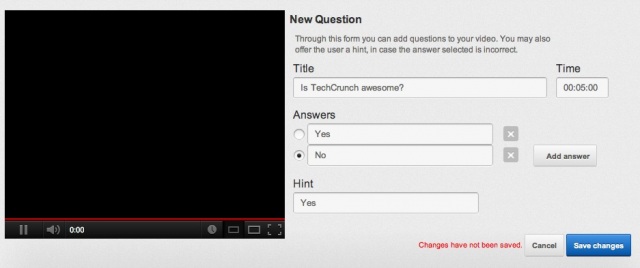
YouTube is testing a feature that allows you to create a multiple choice quiz.

Picture by Anthony Ha

This. Changes. Everything.

What a deliciously disruptive idea! I would have never thought of taking something like multiple choice tests and making them digital. Seriously, how do people come up with such crazy creative ideas? I'm sarcastically blown away with how this will change the classroom. Consider this:
  • Teachers won't have to tell (or yell at) students to NOT write on the test. Teachers will never need to photocopy and re-photocopy those multiple choice tests that they made 15 years ago.
  • Teachers won't have to waste time plugging in the Scantron machine or risk hearing loss when the Scantrons are run through the machine and are turned into replica AK-47s.
  • Teachers will never again have to try and decode the Scantron analysis sheet. All the data-analysis can be done mindlessly by YouTube.
  • Rather than wasting time allowing children to learn by doing something in a context and for a purpose, teachers can reduce needlessly complex and ambiguous concepts such as citizenship, creativity, communication and critical thinking to a YouTube video and an online multiple choice quiz.
Let's stop here for a minute before my sarcasm breaks the Internet.

In case you missed it, I think this is the:

Worst. Idea. Ever.


Why?

1. Multiple choice tests are a primitive form of assessment that has no place in a classroom that is interested in allowing children to construct an understanding for themselves in a way that encourages them to show not only what they know but what they can do with what they know.

2. Too often technology is used as a "shoehorn" -- that is, in a way that merely supplements traditional, less-than-optimal teaching and learning practices which ultimately leads the classroom to revert to the way it was before.

3. Using multiple choice tests on YouTube videos makes me think of what Seymour Papert said: "Before the computer could change school, school changed the computer."

4. The Khan Academy and online multiple choice tests are the definitive way of improving school by changing nothing. In other words, online multiple choice tests is nothing more than more of the same and is a great example of how not to use technology.


Let me be crystal clear: I use technology everyday and I know that if educators ignore technology, we risk becoming irrelevant to our students. This is unacceptable. If we are so drunk on technology that we spend all our time making our jobs easier by "improving" what we've always done, we risk being irrelevant to our students.

For every discussion we have about technology, we need to talk twice about pedagogy.

Chris Lehmann's comment on this post speaks volumes:
Simply put... if the best use of the technology at our disposal we can imagine is the evolutionary filmstrip and the evolutionary scantron, our failure will be epic and tragic.

Monday, May 21, 2012

Stephen Krashen on Flunking the Test

This post was first published on Anthony Cody's blog here.

This was written by Dr. Stephen Krashen who is a professor emeritus at the University of Southern California. He has written numerous books on his research into literacy and language acquisition. In recent years he has emerged as a persistent voice pointing towards the basic steps we should take to build literacy and strong academic skills for our students.

by Stephen Krashen


In "Flunking the Test," Paul Farhi concludes that the media has seriously under-reported the successes of American education and have taken the pronouncements of self-proclaimed "reformers" at face-value. Farhi backs up his argument with real data: American students' performance on international tests is much better than critics say it is, and college attendance has increased enormously.

Farhi cites Pedro Noguera, who in turn mentions a Dan Rather program that "explored the link between school performance and poverty, a subject often ignored or noted only in passing in many stories about academic achievement." As Farhi notes, research shows that poverty is "the single greatest variable in educational achievement."

Poverty is, in fact, the issue. While American students' scores on international tests are not as bad as critics say they are, they are even better when we control for the effects of poverty: Middle-class students in well-funded schools, in fact, score at or near the top of world. Our average scores are respectable but unspectacular because, as Farhi notes, we have such a high percentage of children living in poverty, the highest of all industrialized countries. Only four percent of children in high-scoring Finland, for example, live in poverty. Our rate of poverty is over 21%.

The implications of this fact are enormous: It means that the "problem" of American education is not ineffective teaching, not teachers' unions, not lack of national standards and tests, and not schools of education: It is poverty.

This conclusion is supported by additional evidence: High poverty means, among other things, lack of food and lack of quality food, lack of health care, and lack of access to books. There is massive evidence documenting the pernicious effect of hunger, illness and limited reading material have on school performance. The best teaching in the world has limited effects when children are hungry, sick and have little to read.

This analysis pulls the rug out from under the current standards movement, a movement that includes not only detailed and "rigorous" standards, but also an astonishing amount of testing, far more than currently required under No Child Left Behind. The standards/national tests movement is based on the unsupported assumptions that our schools are doing poorly (not true), that ineffective teaching is the major problem, and that standards and tests are necessary to insure a more rigorous curriculum, as well as frequent and precise evaluations of student progress and teacher effectiveness.

Ironically, the cure proposed for the non-existent crisis will prevent schools from improving: The money we are spending on national standards and starting to spend on national tests, could be used to provide better nutrition, improved health care, and libraries for children of poverty. In other words, we can protect children of poverty from at least some of the effects of poverty. This will not only raise overall test scores, it will lead to a better life for millions of American children.

What do you think? Are we wasting billions on tests that would be better spent elsewhere? Is poverty the real problem here?

References and sources:
Farhi, P. 2012. Flunking the Test. American Journalism Review.
American students in well-funded schools ...
Berliner, D. The Context for Interpreting PISA Results in the USA: Negativism,
Chauvinism, Misunderstanding, and the Potential to Distort the Educational Systems of Nations. In Pereyra, M., Kottoff, H-G., & Cowan, R. (Eds.). PISA under examination: Changing knowledge, changing tests, and changing schools. Amsterdam: Sense Publishers. In press.
Bracey, G. 2009. Education Hell: Rhetoric vs. Reality. Educational Research Service
Payne, K. and Biddle, B. 1999. Poor school funding, child poverty, and mathematics
achievement. Educational Researcher 28 (6): 4-13.
Poverty and hunger, health and access to books:
Berliner, D. 2009. Poverty and Potential: Out-of-School Factors and School Success. Boulder and Tempe: Education and the Public Interest Center & Education Policy Research Unit.
Coles, G. 2008/2009. Hunger, academic success, and the hard bigotry of indifference. Rethinking Schools 23 (2);
Krashen, S. 1997. Bridging inequity with books. Educational Leadership 55(4): 18-22.
Krashen, S. 2011. Protecting students against the effects of poverty: Libraries. New England Reading Association Journal 46 (2): 17-21.
Rothstein, R. 2010. How to fix our schools. Economic Policy Institute, Issue Brief #286.

Tuesday, March 27, 2012

Standardization vs. Professionalization

In her post Standardization vs. Professionalization, Ariel Sacks writes:

I believe the drama of the current moment in education is a conflict between two opposing forces attempting to take the country's education system in two different directions.

On one side, you have the movement toward standardization--of curriculum, standards, assessments, teaching methods, and ultimately, students. On this side, testing is the way forward. It's a way to apparently control a multitude of factors that affect teaching and learning. It's a way to make teaching a simple matter of learning techniques to get results. It implies that success looks the same for every child, that we can count on "if...then..." scenarios to work every time, and that the arts have no value.

The movement toward standardization means lots of money is needed to fund the creation and administration of more tests, the development of test preparation materials and stronger data tracking systems. These endeavors add up to a booming industry funded by our tax money. This movement also means less money and time is needed to prepare, support and retain quality, professional teachers, since most curriculum and assessment decisions are made without teacher input and creativity.

On the other side, you have a powerful movement working to create a real teaching profession, something we've never really had, due in large part to sexism inherent in the way the teacher's job has historically been structured. Teachers are taking on more leadership at all levels of the educational system, revealing the complexity of teaching and child development, and bridging the huge divide between the ed policy world and the classroom. Parents are speaking up about the value of their childrens' teachers and the diverse needs of their children.

Lately there are forceful attempts by the standardization movement to take control of the professionalization of teaching, by defining great teaching as that which causes the greatest rise in student standardized test scores. Will professionals and taxpayers allow this false idea to guide the education of America's children?

Tuesday, March 20, 2012

We need more teachers like this

If you are proud of your high testsandgrades or ashamed of your low ones, you are a part of the problem.

But if those who get low testsandgrades speak up against them they are easily labelled as 'sour grapes'.

That's why those who get high testsandgrades have a responsibility to speak up and reject any accolades. Because they know that standardized tests measure what matters least. They also know that the costs of standardized testing are entirely unacceptable.

In New York, teachers are now evaluated and ranked according to their students' standardized test scores. While it's true that we should all speak out against this malpractice, it's especially important that the high scoring teachers do so.

That's why Julie Cavanagh, a teacher from Brooklyn, is so important. Cavanagh writes::
According to the numbers, I am a highly effective New York City public school teacher. But you won’t see me jumping for joy over the news.
This is one of many of ways to refuse our cooperation with test and punish accountability regimes.

Of course another method is for parents to say "Not with my child you don't".

Wednesday, February 29, 2012

Everything works

Punish a child to teach him a lesson and he'll learn that you can use power over those weaker than you to get what you want.

Reward students for high testsandgrades or punish them for low testsandgrades and you teach children that testsandgrades, not learning, are the point of school.

Use multiple choice tests as your primary form of assessment and you teach children that in the real world you don't have to generate your own response to solve problems.

Frame learning as a competition and you force children to see their peers as obstacles to their own success.

Assign boatloads of nightly homework to children and you encourage them to see learning as this thing they just need to get done before they can return to their regularly scheduled lives.

Praise administrators for their district or school's standardized test scores and you push them to place pressure on their teachers to attain higher scores by whatever means available.

Mandate teachers to attend one-size-fits-all, "drive-by" professional development sessions and you teach them that professional development is something done to them rather than by them.

Catch children being good and you encourage them to be good so they get caught.

Everything "works". The question is: works to do what?

Thursday, February 2, 2012

Rethinking Exam Week

Lori Cullen is the principal of Erin Woods School in Calgary, Alberta, Canada. She blogs here.

by Lori Cullen

One has to ponder the question “why,” on many occasions. A recent “why” has come to me this month as January is the mid-term point of the school year and most high schools are in the midst of exams that mark the end of term one. “Finals” as they are called run for three weeks. Three weeks of no classes, and no learning. When we know better, why do we do this? Why do we persist in this practice?

The ironic part is we know better. We know that high stakes, final exams that provide no opportunity for feedback or further learning are not representative of a student’s knowledge or understanding, and do nothing to further a student’s knowledge or understanding which is arguably the point of school.

Image via Wikipedia
An argument that is often launched for those who believe in and rely on final exams often goes something like this… “How will I know what they have learned, if I don’t give them an exam? How will they prove that they have learned anything at all?” To those, I offer up the following response:


  1. Formative Evaluation – In his book Visible Learning by John Hattie, the effects of formative Evaluation were found to have a d = .90 or standard deviation of .90. Hattie describes this effect size as, “…a 1.0 standard deviation increase is typically associated with advancing student children’s achievement by two to three years, improving the rate of learning by 50%…” (pp 7 of Visible Learning). Thus, formative evaluation strategies in the classroom would not only give teachers information about what a student knows, but work to increase a student’s rate of learning by almost 50%.
  2. Self-reported Grades d=1.44 where Cohen argues, “…an effect size of d=1.0 should be regarded as a large, blatantly obvious, and grossly perceptible difference…” (pp 8 Visible Learning). Hattie found that even without tests, “…high school students have a reasonably accurate understanding of their level of achievement… This should questions the necessity of so many tests when students appear to already have much of the information the tests supposedly provide…” (pp 44 Visible Learning).
  3. Feedback (d=.73). “When teachers seek, or at least are open to feedback from students as to what a student knows, what they understand….then teaching and learning can be synchronized and powerful.” (pp 173 Visible Learning)


When assuming the reason for a final exam is to find out what students know or best case what students have learned, my question back to a teacher would be “Why don’t you already know?” I believe that if effective teaching and learning practices such as formative evaluation, self-reported grades and feedback are consistently and appropriately utilized by teachers, a final exam would simply provide them with a weak, irrelevant example of what they already know.

Hattie, John, Visible Learning A Synthesis of Over 800 Meta-Analyses Relating to Achievement, Routledge, 2009.

Monday, January 16, 2012

Using test scores to pick a school

Using standardized test scores to pick a school for your children to attend is the equivalent of kicking the tires before buying a car.

To fully grasp why this is true, there's a lot to know about the arcane underpinnings of standardized tests; however, there is a single principle that summarizes what you need to know:
Never treat a test score as a synonym for what children have learned or what teachers have taught.
 Again, this too can be true for lots of reasons, but there is a single principle that summarizes what you need to know:
A right answer on a test does not necessarily indicate understanding and a wrong answer does not necessarily indicate a lack of understanding.
Show me someone who places high stakes on one single test, and I'll show you someone who does not understand how testing is unavoidably incomplete and inherently prone to error.

Saturday, January 14, 2012

Holding K-12 Hostage

When I ask people to think about why we grade students, they tend to provide three reasons:
  1. Motivate students
  2. Rank and Sort students
  3. Provide feedback for students
In short, we have no business using grades to do number 1 or 2 and grading has never done a good job of 3. I've written more about this here.

A fourth rational for grading comes up regularly. In fact, you might have even made this argument:
We need testsandgrades in K-12 so our children can get into post secondary education.
I have a couple responses:
  • Some of the worst forms of teaching and learning exist in post secondary colleges and universities. The only anecdotal evidence we might need to prove this is for those who attended post secondary to remember their experiences in lecture halls that could fit 50 to 400 students at a time. Holding K-12 hostage to such pathetic standards seems irresponsible.
  • While it's true that some universities look at some of the grades from a student's high school transcript, how many universities look at a student's grades from elementary? Middle school? or even grade 11? Because the only grades that post-secondary institutions look at is from the final year of high school, K-11 can and should be liberated from the clutches of post-secondary's obsession with testsandgrades.
  • I know more than a couple university professors and I know a president of a local college, and I know that they would all far rather K-12 focus less on testsandgrades and more on inspiring students to have a love for learning. In other words, university folk understand that "a preoccupation with achievement is not only different from, but detrimental to, a focus on learning." (Alfie Kohn). The research confirms that an orientation towards improving your learning, rather than proving it sets children up for the most success. In learning oriented classrooms, students are less worried about looking smart and more about becoming smart. The most successful teachers and students understand that proving how good you are over and over again is an inferior use of your time especially when you could be using your time getting better.
  • We have a dangerous pre-occupation with preparation. College does not begin in kindergarten -- kindergarten begins in kindergarten. Children in middle school are not simply miniature versions of high school or university students. Children of all ages have their own unique, individual needs. What might be appropriate for a high school student might be developmentally inappropriate for a middle or elementary student.
  • In Alberta, only one-third of students attend university. Does it make sense to mold K-12 public education, which is for everyone, in the image of post-secondary education where  two-thirds of our students will not attend.
To sum up, I'm sick and tired of being told I can't innovate and improve my assessment practices in K-12 because of post secondary's archaic grading practices.

Thursday, December 22, 2011

Taught to think

This letter to the editor appeared in the Sylvan Lake (Alberta, Canada) News on November 23, 1961:
At the regular montly meeting of the Women's Institute,  W.W. Blick, principal of the Sylvan Lake School, was the guest speaker. 
He stated that education to many of us meant the sum total of all that could be remembered of what was in the text books and the teachers' lectures. 
Children are still graded on examinations and parents are concerned mainly on that grading. In this respect, education is failing because it does not teach people how to think. 
In this, Mr. Blick stated, we are ahead of the Russians. They are not teaching their people how to think because a thinking socieity would not tolerate a totalitarian society. We know and feel that the future of our world is as H.G. Wells put it, " A race between education and catastrophe." 
It is going to take a thinking people in some of the problems that face the world - unemployment, world trade, population pressures. If these problems are to be solved, the young and old must be taught to think.


Wednesday, December 21, 2011

Testing and teaching are at odds

I will look at any additional evidence to confirm the opinion to which I have already come.
 --Lord Molson, British politician (1903-1991)

The Washington Post ran a piece On Leadership July 18 and 19, 2011, that featured responses to the Atlanta cheating scandal from Dan Ariely, Arne Duncan, Howard Gardner and Steven Pearlstein.

Despite the evidence mounting against high stakes, standardized testing, Arne Duncan and many other advocates for test and punish accountability want to stay the course with their "despite cheating scandals, testing and teaching are not at odds" mantra. So powerful is Duncan's need for consonance, his reaction to disconfirming evidence is to criticize, distort and dismiss cheating as the sole responsibility of those individuals who did the cheating.

In other words, Duncan is saying "mistakes were made, but not by me." This mental jockeying is known as confirmation bias, and at the moment Duncan is its poster boy.

False dichotomies make choosing easy. Duncan frames his argument very carefully -- either you are for accountability (with him) or you are against accountability (against him). But in reality, the situation is far from this simple.

In her book Willful Blindness, Margaret Heffernan writes about "the ostrich instruction":
We all recognize the human desire at times to prefer ignorance to knowledge, and to deal with conflict and change by imagining it out of existence... In burying our heads in the sand, we are trying to pretend the threat doesn't exist and that we don't have to change... A preference for the status quo, combined with an aversion to conflict, compels us to turn a blind eye to problems and conflict we just don't want to deal with.
Sometimes it's the leaders with the most power and responsibility who are the most blind because they believe they know what they were doing -- or feel like they have to look like they know what they are doing.

In their book Mistakes Were Made but not by Me, Carol Tavris Elliot Aronson write:
In a study of people who were being monitored by magnetic resonance imaging (MRI) while they were trying to process dissonant or consonant information about George Bush or John Kerry, Drew Westen and his colleagues found that the reasoning areas of the brain virtually shut down when participants were confronted with dissonant information, and the emotion circuits of the brain lit up happily when consonance was restored. These mechanisms provide a neurological basis for the observations that once our minds are made up, it is hard to change them. 
Indeed, even reading information that goes against your point of view can make you all the more convinced you are right.
In light of this, it's not surprising that when test and punish accountability supporters like Arne Duncan are faced with evidence that shows cheating as an inevitable and inherent characteristic of high stakes testing, they simply turn to discrediting the facts and become even more committed to their own argument. At this point, I'll be fair to Duncan and say that this behavior is as predictable as it is unfortunate, especially if he believes staying the course is his only option. Because people become more certain they are right if they can't undo it, nothing is more dangerous than an idea when it's the only one you have.

At this point, I'm reminded of what Edward De Bono meant when he said:
If you never change your mind, why have one?
This is precisely why we need to listen to people like Bob Schaeffer from Fairtest who say:
The failure of NCLB and its state-level clones cannot be reversed by “staying the course,” “raising the bar” or any of the other faith-based notions frequently invoked by high-stakes testing true-believers.

Monday, December 19, 2011

Who needs tests?

Some people need standardized testing because without them they would know nothing about their schools.

This says less about how good the tests are and more about how little some people know about their schools and their children's learning.

This is precisely why the need for testing intensifies the further away you get from the children.

Friday, November 18, 2011

Test scores are low, make them go up

“Errors, like straws, upon the surface flow;
He who would search for pearls must dive below.”

~ John Dryden

Some people make the case that good teaching and real learning are the best ways to achieve high test scores. The argument goes something like this: Help your students become thinkers and learners and the scores will take care of themselves.

Let's for the moment ignore the evidence that suggests this might not be true. 

There is a growing body of evidence that shows you can improve test scores without improving learning. Some of these strategies range from illegal cheating such as changing students answers -- to legalized cheating, otherwise known as teaching to the test. 

Cheating has always been frowned upon, and at one time so was teaching to the test, but in response to the ever increasing demands for higher and higher test scores, teaching to the test has gone from something even the test-makers vehemently opposed to something that is encouraged as best practice. And when the pressure to raise scores threaten the very existence of schools and the employment of educators, system-wide forms of cheating are encouraged from as high up as administrators and superintendents.

In reaction to this systemic pressure, many educators now experience professional development as nothing more than "test scores are low, make them go up."

Anyone who has played the game of school as a student knows that there are ingenius ways to achieve high grades without learning too much and there are also ways to learn a lot and still earn low grades.

Here's what I mean. Here are two students:

One student has a teacher that artfully guides them to play an active role in constructing and discovering a love for learning; the other has a teacher that focuses on scripted test preparation and direct instruction that has this student play a passive role in reproducing right answers on tests. The former experiences school as something done by them -- the latter as something done to them.

Here are their testsandgrades data:


So which student is which? Which one sees learning as a means to an end and which sees it as an end in and of itself? Which one has a teacher that artfully guides them and which has a teacher that does test prep?

The information provided about Liam and Samantha is as common-place as it is limited, which means we can't possibly know which student is which based on the (lack of) information provided --and when I say we need more information, I don't mean we need more testsandgrades.

The ultimate point here is that inferences made from testsandgrades can be undermined leaving the successful and superficial students indistinguishable. The reductionist data gleamed from testsandgrades is by definition necessarily incomplete -- making the use of this limited and narrow kinds of data to make any kind of decisions or judgements about a student at best unhelpful and at worst harmful.

Perhaps the most disturbing part of this whole debacle that I call chasing "testsandgrades and calling it learning" is that there is a whole generation of beginning teachers who have known no other education than one that makes testsandgrades both the means and end to learning. The distinction many people make between real learning and testsandgrades makes no sense to them because they have been taught from the beginning that testsandgrades are good teaching and learning; they simply do not have any other model to draw from.

The mantra of test scores are low make them go up and the cult following we have in our culture of education for testsandgrades may prove to do more long-lasting harm to our education systems than we can fathom.

Saturday, October 8, 2011

Where are the pro-testing cartoons?


I was reading Larry Cuban's blog and was struck by a question he posed.

Where are the cartoons that support tests?

If you know of one, please let me know.

Thursday, September 15, 2011

Daniel Koretz on Testing


Learning about what's under the hood of standardized tests will never be confused with something fun. And yet, this is precisely why we need people like Daniel Koretz who can make the arcane underpinnings of standardized testing more accessible to the masses.

If you want to broaden your current understanding for standardized tests, I suggest you get a copy of Koretz's book Measuring Up: What Educational Testing Really Tells Us.

Here are is a post on Rethinking Reliability that highlights some of Koretz's work.


Monday, September 5, 2011

Why test scores should never drive professional development

Here are but a few reasons why test scores should never be used to drive the professional development of teachers:

  • tests were not designed to drive a teacher's teaching or a learner's learning. In other words, we should never treat a test score as synonymous with what was learned or what was taught
  • tests can only measure a subset of the goals of education
  • test scores do not provide a direct or complete measurement of educational achievement
  • tests are incomplete measures, proxies for more comprehensive measures and authentic performance assessments
  • tests are generally very small samples of a very large domain of knowledge and skill.
  • focusing on test scores tend to reduce teacher professional development to "test scores are low, make them go up"
  • a case can be made that measurable outcomes may be the least significant results of learning, so focusing with laser like precision on what can be measured will by definition encourage teachers to ignore the kinds of things that tests can't assess such as ethics, creativity, sense of humour, empathy, etc
  • the need to evaluate students should never determine curriculum content or pedagogy
  • focusing on the limited and narrow scope of test scores encourages teachers to confuse valuing what we measure with measuring what we value.
  • focusing on test scores encourages teachers to confuse learning and then there happens to be a test with learning because there is a test. We risk making tests the raison d'être for learning.
  • focusing on test scores encourages everyone to see assessment as something done to kids rather than by them.
  • No one assessment, no matter how elaborate, valid or reliable should be used to make important decisions.
Using test scores to drive or guide a teacher's professional development may lead teachers to know more about raising the scores than raising children.

Saturday, September 3, 2011

More on opting out of testing

Even in the face of the costs of standardized testing, some believe that testing can play a part of an education system.

I hear this a lot.

The problem with such a statement is that it at best down-plays the dominant role standardized testing plays in our current accountability culture and at worst sells a lie that confuses moderation and compromise with capitulation.

Some progressive educators have been screaming about the injustices of standardized testing for a very long time. And some of them are getting frustrated.

Shawn Johnson from Towson University puts it this way:
Educators are frustrated by the exclusion of teachers from the larger debate on education reform and policy in the United States. Individual classroom teachers and researchers have been highlighting for years the deleterious effects of focusing solely on success or failure with regard to standardized tests. And even now, with the revelation that high-stakes environments are perfect breeding grounds for desperation and resulting dishonesty, the dispiriting march through another year of test preparation must continue. 
In a political and cultural environment that at best feigns listening to educators and at worst demonizes them, the most active public school advocates — like Mr. Slekar — are beginning to feel that opting their children out of completing the state tests is the only message that will get through. Those who began their research into the issue are finding it remarkably easy to do, despite the dissembling of school officials when asked for information.
In Canada, I've written about opting out of testing here, and others have written here and here.

In the United States, the Innovative Educator is calling for a national movement for opting out of testing.

Alfie Kohn offers these practical strategies to save our schools from testing.

Most politician and policy maker have neither the know-how or courage to stand against standardized testing. I have little faith they will do anything different until the prevailing winds no longer blow in favor of these tests. Where the body goes, the shadow follows -- most politicians are shadows.

I believe with educators' know-how and the public's courage, together we can refuse our cooperation and no longer allow our children's education to be reduced to data for someone else's spreadsheet.

My children will never write a Provincial Achievement Test, and I will continue to publicly advocate like I am here. That's what I'm doing.

What are you doing?