Showing posts with label Seymour Papert. Show all posts

Saturday, March 21, 2015

Making school worse, faster

This post appeared in a series titled: The Global Search for Education: Our Top 12 Global Teacher Blogs that answered the question: What are the biggest mistakes teachers make when integrating technology into the classroom.


“Before the computer could change school, school changed the computer.”

-Seymour Papert

I love technology, and I use it every single day. I teach with it, and I learn with it. Without technology, my teaching and learning would suffer.

However, too much of what is being sold as “Education Technology” merely shoehorns technology in a way that supplements traditional, less-than-optimal teaching and learning practices which ultimately leads the classroom to revert to the way it was before.

Here are three mistakes schools and teachers make when integrating technology:
1. Technology is used to prove, instead of improve: Test and punish accountability regimes have convinced (and often mandated) that technology be used to mine students for spreadsheet friendly data. For too long, teachers have been lured by the efficiency of multiple-choice tests, and with the use of technology, it is easier than ever to reduce learning to tests and grades.
Psychologist Carol Dweck reminds us to ask, “Why waste time proving over and over how great you are, when you could be getting better?” Proving and improving are not the same thing and if we aren’t careful, technology can be used in wonderful ways to prove the quality of our schools and teachers without improving learning.
2. Technology is used by the teacher, not the students: Interactive White Boards (Smartboards) are the definitive example of how schools can spend a lot of time, effort and money on technology that is almost exclusively used by the teacher while students sit passively, waiting to be filled with knowledge.
In his book The Pedagogy of the Oppressed, Paulo Freire called this the banking concept of education where, “Education thus becomes an act of depositing, in which the students are the depositories and the teacher is the depositor”. Too much of our school’s technology demands that students simply sit and do nothing.
3. Poor Pedagogy + Technology = Accelerated Malpractice: Classroom management and tracking programs like ClassDojo are used to elicit compliant behaviour and are sold as a daring departure from the status quo when really they are a tactic taken from the same behaviourist strategies that have been strangling the life out of classrooms for decades.
Schools and teachers who ignore technology risk becoming irrelevant to their students, and this is unacceptable. However, it is equally wrong to use technology as a 21st century veneer on the “sit-and-get, spew-and-forget” model of learning that has dominated our schools for too long.

Teachers and schools must be mindful of their pedagogical practices, because if they are not, technology will only make things worse, faster.

Wednesday, August 21, 2013

It took only six years before I wanted to quit teaching

I started teaching in 2000.

I'm now starting my 14th year.

In my chapter Reduced to Numbers: From Concealing to Revealing Learning, I reflect on my 13 years:

I am not the same teacher I used to be. When I started, I was focused on power and control. I assigned loads of homework, dished out huge penalties for late assignments, assigned punishments for rule-breaking behavior, and averaged marks to determine the students’ final grade. I did some of these things because I was trained to do so in university. However, most of these teaching strategies were being done mindlessly and, for the most part, I was simply teaching the way I was taught.

It took only six years before I wanted to quit teaching. I had become increasingly unhappy with my teaching and my students’ learning. I was tired of laboring through hours and hours of marking, and I hated nagging kids to complete their homework. Instead of students asking “What is this question worth?” I wanted them to actually get excited about the content. I wanted change, and I came close to thinking that change required me to leave the profession.
Instead of pulling the plug on what could have been a short teaching career, I started to question the traditional pedagogy that I had so mindlessly adopted. I began asking questions that would challenge the status quo. Many professional development conferences provide teachers with opportunity to ask questions such as “How do I mark better?” or “How do I get my students to do their homework?” At first glance these look like challenging and provocative questions, but they are still questions that promote more of the same. Far more powerful questions are “Why do I mark?” or “Why do I assign homework?” Investigating the motives for our actions, rather than merely examining our methods of implementation, is a better use of our time, particularly if the subject in question is a belief or habit that we’ve come to accept as a given truth. I have come to see that:

"[t]here is a time to admire the grace and persuasive power of an influential idea, and there is a time to fear its hold over us. The time to worry is when the idea is so widely shared that we no longer even notice it, when it is so deeply rooted that it feels to us like plain common sense. At the point when objections are not answered anymore because they are no longer even raised, we are not in control: we do not have the idea; it has us." (Kohn, 1999a, p.1) 
For too long, I was letting schooling get in the way of my teaching and too many of my teaching practices were based on pedagogy that was at best unhelpful and at worst harmful to my long-term goals. Through critical questioning and extensive research, I came to the conclusion that my pedagogy had to revolve around one priority: learning. If there were things that worked to sabotage learning, then it was my professional responsibility to remove them.

Since 2006, I have worked to identify and remove things like grading that traditional school has done for so long. And when I share this with others, I receive mixed responses. Some listen intently, nodding their heads in agreement, as if deep down they have always sensed something wrong with what Seymour Papert (1988) described as School with a capital S, which is a place that he explains as having a bureaucracy that has its own interests and is not open to what is in the best interest of the children. Unfortunately, when most people close their eyes and think of their Schooling, many have experienced no other kind of School than the one with a capital S. Some listen in shock and awe at how school could even function without such things as grading. The people who have a hard time comprehending how children could learn without extrinsic manipulators concern me the most. They are so invested in traditional schooling that they have never questioned its foundation. Unfortunately, some have a distrustful view of the nature of children; they believe that without grading there would be nothing to stop children from running amok.

Thursday, October 4, 2012

This. Changes. Everything.

If you're like me, you know all too well how little school has changed over the last 150 years. Many people hold technology up as the long awaited disruptive force that will smarten up our glacial education systems.

The wait is over.

Change is here!

If you thought the Scantron machine and the Khan Academy were disruptive forces on education, you're going to blow your load when you hear about this.

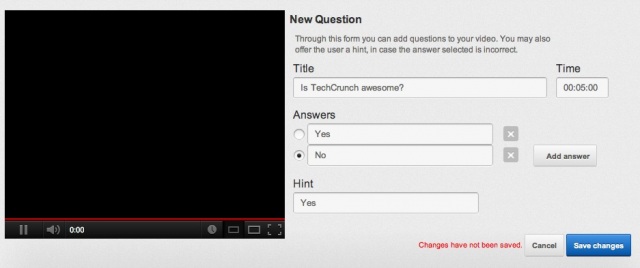
YouTube is testing a feature that allows you to create a multiple choice quiz.

Picture by Anthony Ha

This. Changes. Everything.

What a deliciously disruptive idea! I would have never thought of taking something like multiple choice tests and making them digital. Seriously, how do people come up with such crazy creative ideas? I'm sarcastically blown away with how this will change the classroom. Consider this:
  • Teachers won't have to tell (or yell at) students to NOT write on the test. Teachers will never need to photocopy and re-photocopy those multiple choice tests that they made 15 years ago.
  • Teachers won't have to waste time plugging in the Scantron machine or risk hearing loss when the Scantrons are run through the machine and are turned into replica AK-47s.
  • Teachers will never again have to try and decode the Scantron analysis sheet. All the data-analysis can be done mindlessly by YouTube.
  • Rather than wasting time allowing children to learn by doing something in a context and for a purpose, teachers can reduce needlessly complex and ambiguous concepts such as citizenship, creativity, communication and critical thinking to a YouTube video and an online multiple choice quiz.
Let's stop here for a minute before my sarcasm breaks the Internet.

In case you missed it, I think this is the:

Worst. Idea. Ever.


Why?

1. Multiple choice tests are a primitive form of assessment that has no place in a classroom that is interested in allowing children to construct an understanding for themselves in a way that encourages them to show not only what they know but what they can do with what they know.

2. Too often technology is used as a "shoehorn" -- that is, in a way that merely supplements traditional, less-than-optimal teaching and learning practices which ultimately leads the classroom to revert to the way it was before.

3. Using multiple choice tests on YouTube videos makes me think of what Seymour Papert said: "Before the computer could change school, school changed the computer."

4. The Khan Academy and online multiple choice tests are the definitive way of improving school by changing nothing. In other words, online multiple choice tests is nothing more than more of the same and is a great example of how not to use technology.


Let me be crystal clear: I use technology everyday and I know that if educators ignore technology, we risk becoming irrelevant to our students. This is unacceptable. If we are so drunk on technology that we spend all our time making our jobs easier by "improving" what we've always done, we risk being irrelevant to our students.

For every discussion we have about technology, we need to talk twice about pedagogy.

Chris Lehmann's comment on this post speaks volumes:
Simply put... if the best use of the technology at our disposal we can imagine is the evolutionary filmstrip and the evolutionary scantron, our failure will be epic and tragic.

Monday, July 16, 2012

Time-traveling teachers

Seymour Papert begins his book The Children's Machine with this thought experiment:
Imagine a party of time travellers from an earlier century, among them one group of surgeons and another of school teachers, each group eager to see how much things have changed in their profession a hundred or more years into the future. Imagine the bewilderment of the surgeons find themselves in the operating room of a modern hospital. Although they would know that an operation of some sort was being performed, and might even be to guess at the target organ, they would in almost all cases be unable to figure out what the surgeon was trying to accomplish or what was the purpose of the many strange devices he and the surgical staff were employing. The rituals of antisepsis and anesthesia, the beeping electronics, and even the bright lights, all so familiar to television audiences, would be utterly unfamiliar to them.  
The time-traveling teachers would respond very differently to a modern elementary school classroom. They might be puzzled by a few strange objects. They might notice that some standard techniques had changed -- and would likely disagree among themselves about whether the changes they saw were for the better or the worse -- but they would fully see the point of most of what was being attempted and could quite easily take over the class. I use this parable to provide a rough-and-ready measure of unevenness of progress across the board front of historical change. In the wake of the startling growth of science and technology in our recent past, some areas of human activity have undergone megachange. Telecommunications, entertainment, and transportation, as well as medicine, are among them. School is a notable example of an area that has not. One cannot say that there has been no change at all in the way we dish out education to our students. Of course there has; the parable gives me a way of pointing out what most of us know about our system of schooling: Yes, it has changed, but not in ways that have substantially altered its nature. The parable sets up the question: Why through a period when so much human activity has been revolutionized, have we not seen comparable change in the way we help our children learn?

Wednesday, May 30, 2012

Before the computer could change School, School changed the computer

There is a lot of talk about how technology is disrupting education in ways that allows students to learn in different ways at any pace, any place and any time. Some elements of education reform has a lot of us pondering how technology will impact schools.

While it's true that School (with a capital S) has not changed very much over the years, we must be mindful of the reforms we impart on public education. After all, tradition for the sake of tradition is no better than change for the sake of change.

We owe it to our children to stop and seriously question whether technology and hyper-personalization should drive our education reforms.

I challenge you to watch the video below and ask yourself: Is this the ideology we want dictating our education systems?


Firstly, you'll note that this video is from 1954 -- makes you wonder why we think talking about iPads is revolutionary.

Secondly, you'll notice that the video features B.F Skinner, the grand-daddy of behavioristic psychology. For those who understand that we learn by constructing our own understanding from the inside while interacting with our environment, this should be a serious red flag.
  • Those who suggest teachers should be replaced by a technology that can simply grade more efficiently are at best revealing their primitive understanding for what education is all about and at worst are exposing their desire to bust teachers' unions and destroy public education. These people play politics and profit from education at our children's peril.
  • The dream of having learners intensely concentrate on using technology quickly becomes a nightmare when it is the technology that is using the learner. When children are mined for data, education becomes something done to them rather than by them. 
  • Technology that is used to elicit correct behaviour (rather than encouraging children to construct their own understanding) is sold as a daring departure from the status quo when really it is a tactic taken from the same behaviourist strategies that have been strangling the life out of classrooms for decades.
  • Technology used in this way turns children into empty receptacles that simply require filling. This is a perfect way to achieve a Pedagogy of the Oppressed. Paulo Freire writes:
"The teacher talks about reality as if it were motionless, static, compartmentalized, and predictable. Or else he expounds on a topic completely alien to the existential experience of the students. His task is to "fill" the students with the contents which are detached from reality, disconnected from the totality that engendered them and could give them significance. Words are emptied of their concreteness and become a hollow, alienated, and alienating verbosity."
  • If technology is used as a way to correct students so as to help them always be certain about their learning, children will only know uncertainty. Alfie Kohn explains:
"When students are simply told the most efficient way of getting the answer, they get in the habit of looking to the adult, or the book, instead of thinking things through. They become less autonomous, more dependent. Stuck in the middle of a problem, they’re less likely to try to figure out what makes sense to do next and more likely to try to remember what they’re supposed to do next – that is, what behavioral response they’ve been taught to produce. Lots of practice can help some students get better at remembering the correct response, but not to get better at – or even accustomed to -- thinking."
  • Technology used this way merely perpetuates education as a spectator sport where the student is expected to play nothing more than a passive role.  
  • There is a reason why Seymour Papert said, "Before the computer could change School, School changed the computer."
It's tempting to get suckered into talking about technology when the real debate is over how children learn. Some might say there is a war going on in schools between behaviourism and constructivism and the kids are losing; while others have written "One cannot understand the history of education in the United States during the twentieth century unless one realizes that Edward K. Thorndike won and John Dewey lost."

Thursday, August 18, 2011

School with a capital S

I was watching this discussion between Paulo Freire and Seymour Papert (30:00) when Papert began to talk about the defining structure of school.

He describes School with a capital S as being about prefabricated curriculum, rows of desks, hand raising, lectures, quizzes, grading...

Ultimately, School is an instrument of control.

Unfortunately, when most people close their eyes and think of their Schooling, many know no other kind of School than the one with a capital S.

Papert strikes with clarity: When it comes to School it has a bureaucracy that has its own interests and it is not open to what is in the best interest of the children.

Saturday, April 2, 2011

Illusion of standardization

The beginning of wisdom is a definition of terms.
Socrates
When "collaboration" is really code for standardization, professional development becomes nothing more than control over actions. 

Just like how mandated sentences strips judgement from judges, so too does standardization deny teachers the ability to teach. Maja Wilson puts it this way:
Mandating practices in the effort to improve teaching paradoxically creates the kind of environment that undermines good teaching. [Standardization] contributes to an environment that actually stunts teachers' ability to make good decisions in the classroom and obscures bad teaching with its illusion of uniformity.
It's not easy to object to standardization; I know a lot of good teachers who believe consistency is a good thing...

While its true that standardization provides us with consistency, it tends to act less like a floor and more like a ceiling. In other words, standardization is attractive because it offers a kind of guarantee, but that guarantee tends to come at an alarming cost.

Seymour Papert describes with chilling accuracy just how costly the illusion of standardization really is:

It is this freedom of the teacher to decide and, indeed, the freedom of the children to decide, that is most horrifying to the bureaucrats who stand at the head of current education systems. They are worried about how to verify that the teachers are really doing their job properly, how to enforce accountability and maintain quality control. They prefer the kind of curriculum that will lay down, from day to day, from hour to hour, what the teacher should be doing, so that they can keep tabs on it. Of course, every teacher knows this is an illusion. It’s not an effective method of insuring quality. It is only a way to cover ass. Everybody can say, “I did my bit, I did my lesson plan today, I wrote it down in the book.” Nobody can be accused of not doing the job. But this really doesn’t work. What the bureaucrat can verify and measure for quality has nothing to do with getting educational results–those teachers who do good work, who get good results, do it by exercising judgment and doing things in a personal way, often undercover, sometimes even without acknowledging to themselves that they are violating the rules of the system. Of course one must grant that some people employed as teachers do not do a good job. But forcing everyone to teach by the rules does not improve the “bad teachers”– it only hobbles the good ones.
If we are to achieve the kind of wisdom that Socrates spoke of, then we need to understand what standardization does and does not do. We need to understand what we are actually prescribing to when we standardize curriculum and assessment.

Children are not widgets that simply require a better regiment of assembly line workers. Children are not interchangeable cogs that would benefit from simply being treated more like their peers.

We have to stop pretending that we can meet one learners' needs by pretending that all learners have the same needs.

We have to stop pretending that highly prescribed curriculums and standardized testing has anything to do with good teaching and real learning.

Our fixation on quantity and control is doing a massive disservice to our children.

In the context of educating children, a proper definition of terms would have us realize that standardization serves to make the shallowest forms of teaching and superficial learning appear successful.

Sunday, March 27, 2011

Why preschool shouldn't be like school

"'College begins in kindergarten.' No it doesn't. Kindergarten begins in kindergarten."
-Sir Ken Robinson

If you are a fan of direct instruction and the banking metaphor of education, you might find it interesting to read Alison Gopnik's Why Preschool Shouldn't Be Like School. The article features two experiments:

In the first study, MIT professor Laura Schulz, her graduate student Elizabeth Bonawitz, and their colleagues looked at how 4-year-olds learned about a new toy with four tubes. Each tube could do something interesting: If you pulled on one tube it squeaked, if you looked inside another tube you found a hidden mirror, and so on. For one group of children, the experimenter said: "I just found this toy!" As she brought out the toy, she pulled the first tube, as if by accident, and it squeaked. She acted surprised ("Huh! Did you see that? Let me try to do that!") and pulled the tube again to make it squeak a second time. With the other children, the experimenter acted more like a teacher. She said, "I'm going to show you how my toy works. Watch this!" and deliberately made the tube squeak. Then she left both groups of children alone to play with the toy. 
All of the children pulled the first tube to make it squeak. The question was whether they would also learn about the other things the toy could do. The children from the first group played with the toy longer and discovered more of its "hidden" features than those in the second group. In other words, direct instruction made the children less curious and less likely to discover new information.
Does direct teaching also make children less likely to draw new conclusions—or, put another way, does it make them less creative? To answer this question, Daphna Buchsbaum, Tom Griffiths, Patrick Shafto, and I gave another group of 4-year-old children a new toy.* This time, though, we demonstrated sequences of three actions on the toy, some of which caused the toy to play music, some of which did not. For example, Daphna might start by squishing the toy, then pressing a pad on its top, then pulling a ring on its side, at which point the toy would play music. Then she might try a different series of three actions, and it would play music again. Not every sequence she demonstrated worked, however: Only the ones that ended with the same two actions made the music play. After showing the children five successful sequences interspersed with four unsuccessful ones, she gave them the toy and told them to "make it go." 
Daphna ran through the same nine sequences with all the children, but with one group, she acted as if she were clueless about the toy. ("Wow, look at this toy. I wonder how it works? Let's try this," she said.) With the other group, she acted like a teacher. ("Here's how my toy works.") When she acted clueless, many of the children figured out the most intelligent way of getting the toy to play music (performing just the two key actions, something Daphna had not demonstrated). But when Daphna acted like a teacher, the children imitated her exactly, rather than discovering the more intelligent and more novel two-action solution.
All this brings new life to an old quote from Seymour Papert:

The scandal of education is that every time you teach something, you deprive a child of the pleasure and benefit of discovery.
But if this is true then perhaps it's not just preschool that shouldn't be like school. Perhaps all learners would be better off if every level of education was a little less like school.

Tuesday, March 16, 2010

Kid Technology

I was reading Gary Stager's blog: Stager-to-Go when I came across a post and video of his about Generation YES.

I love the message that this video portrays. That is - the days of the jug and mug - we pour what we know theory of learning - is done. Never has it been more evident that kids can know more than their teacher.

This reminds me of a discussion I had with a teacher who, when exposed to the idea social networking with students (Twitter, Facebook, discussion forums) said that kids misbehave far too much to be trusted with such tools and that they would not stay 'on-task' or 'focus' enough. Essentially, this teacher believed that kids couldn't be trusted with using social networking in school - and that we shouldn't allow them to use it until they can prove to be trustworthy.

This line of thinking is concerning for me, to say the least. First of all, does anyone really believe that these kids will wait for our permission? I mean, they are already living social networking. Secondly, if kids are not provided the opportunity for guidance and modelling, how will they ever become 'better behaved'? And thirdly, do you have any idea the kind of resentment these kids will develop for educational dinosaurs who refuse to allow social networking into their lamenated lesson plans?


Seymour Papert on Generation YES and Kid Power from Gary Stager on Vimeo.