
Friday, March 5, 2010

Infectious Passion
Here is a TEDtalk with Kiran Bir Sethi where she discusses how people can be infected with a kind of passion for anything.
What she describes is the importance of children playing an active role in their education. No longer can we afford to 'school' children in school. We have to move beyond the sit-get-spit and forget kind of schooling.
How much must you hate your job if you only ever do it when you are paid to? And how much must students hate school if they only ever do it when they are at school? Kiran Bir Sethi is so right when she speaks about the need to blur the lines between school and life. That education is about imbedding learning into real life.
When I share this sentiment with others, I inevitably find the pessimists and the cynics who will say this is all utopian or idealistic, and that the system is far bigger and more powerful than I could imagine.
Maybe.
But I echo Kiran Bir Sethi when she says - If not us, then who? If not now, then when?
Kiran Bir Sethi: TEDIndia 2009
What she describes is the importance of children playing an active role in their education. No longer can we afford to 'school' children in school. We have to move beyond the sit-get-spit and forget kind of schooling.
How much must you hate your job if you only ever do it when you are paid to? And how much must students hate school if they only ever do it when they are at school? Kiran Bir Sethi is so right when she speaks about the need to blur the lines between school and life. That education is about imbedding learning into real life.
When I share this sentiment with others, I inevitably find the pessimists and the cynics who will say this is all utopian or idealistic, and that the system is far bigger and more powerful than I could imagine.
Maybe.
But I echo Kiran Bir Sethi when she says - If not us, then who? If not now, then when?
Kiran Bir Sethi: TEDIndia 2009
Thursday, March 4, 2010
Change within Alberta Education
Transformational change appears to be on the horizon for Alberta Education. Some of the key leaders in Alberta's Education system have shown themselves to be of the progressive nature.
The Alberta Teachers' Association has shown to be a true professional association in its most recent Real Learning First Initiative that truly advocates for a better system of education for students and teachers.
The Education Minister Dave Hancock has shown very positive signs of being a minister that 'gets it'.
And the Province as a whole has shown signs of understanding what matters most through the Inspiring Education and Setting the Direction Initiatives.
So what's left. Well, there is a lot of work to be done. Alberta is at an educational crossroads.
An important step was taken on March 1, 2010, when Deputy Minister Keray Henke announced changes to the organization structure of Alberta Education to reflect strategic alignment with the province's priorities.
Because of this realignment of priorities, Dr. Jim Dueck, the Assistant Deputy Minister, will pursue other opportunities. This move potentially signifies a new direction for Alberta Learning.
Dueck's history with Alberta Education at the government level began in 1998, but what you really need to know is that Dueck played a role in creating the pshycometric obsession of measuring and testing inside Alberta Learning has today. His role as Assistant Deputy Minister (ADM) of System Improvement and Reporting and later ADM of Accountability and Reporting helped push this province down the path of high stakes testing and test and punish styled accountability.
The Accountability and Reporting Division played a role in encouraging the proliferation of the Learner Assessment Branch that administers Provincial Achievement Tests, which by the way, has seen its budget triple from $4 million to $12 million since the mid 1980s. Comparing this to the rather static curriculum budget of $4 million, it is clear that the Accountability and Reporting Division's focus on psychometric assessment and high-stakes accountability had significant influence in Alberta Learning.
The Accountability and Reporting Division played a role in a number of government initiatives that have proven to be, to say the least, debacles.
This included Computer Adaptive Tests. Essentially this was a massively expensive, on-line multiple choice testing program that automatically adjusts its questions to match the students' abilities. Three major issues plagued Computer Adaptive Tests. Firstly, teachers are ultimately responsible, both legally and professionally, for evaluating and reporting student progress; secondly, the current emphasis on standardized testing programs does little to address the individual needs of students and diverts precious resources away from the classroom; and thirdly relying on standardized testing programs to determine school and school-system performance misrepresents the work of teachers and schools.
A second debacle includes Grade Level Achievement which was rightfully opposed by the ATA who encouraged parents and teachers to remember that students are Always More Than a Number. This GLA reporting initiative and accompanying data management bureaucracy focuses solely on the collection of a single whole number which lends itself nicely to datamongers who worked in the Accountability and Reporting Division, but offer nothing of value for teachers, parents and students to actually improve.
Whether Dr. Dueck chose to exit on his own or if he was told to take a hike may be entirely inconsequential, as what matters most now is how the government deals with the elimination of the Accountability and Reporting Division. Does this signify a move towards transformational change?
There are optimists and there are cynics. I have decided to be optimistically skeptical.
The Alberta Teachers' Association has shown to be a true professional association in its most recent Real Learning First Initiative that truly advocates for a better system of education for students and teachers.
The Education Minister Dave Hancock has shown very positive signs of being a minister that 'gets it'.
And the Province as a whole has shown signs of understanding what matters most through the Inspiring Education and Setting the Direction Initiatives.
So what's left. Well, there is a lot of work to be done. Alberta is at an educational crossroads.
An important step was taken on March 1, 2010, when Deputy Minister Keray Henke announced changes to the organization structure of Alberta Education to reflect strategic alignment with the province's priorities.
Because of this realignment of priorities, Dr. Jim Dueck, the Assistant Deputy Minister, will pursue other opportunities. This move potentially signifies a new direction for Alberta Learning.
Dueck's history with Alberta Education at the government level began in 1998, but what you really need to know is that Dueck played a role in creating the pshycometric obsession of measuring and testing inside Alberta Learning has today. His role as Assistant Deputy Minister (ADM) of System Improvement and Reporting and later ADM of Accountability and Reporting helped push this province down the path of high stakes testing and test and punish styled accountability.
The Accountability and Reporting Division played a role in encouraging the proliferation of the Learner Assessment Branch that administers Provincial Achievement Tests, which by the way, has seen its budget triple from $4 million to $12 million since the mid 1980s. Comparing this to the rather static curriculum budget of $4 million, it is clear that the Accountability and Reporting Division's focus on psychometric assessment and high-stakes accountability had significant influence in Alberta Learning.
The Accountability and Reporting Division played a role in a number of government initiatives that have proven to be, to say the least, debacles.
This included Computer Adaptive Tests. Essentially this was a massively expensive, on-line multiple choice testing program that automatically adjusts its questions to match the students' abilities. Three major issues plagued Computer Adaptive Tests. Firstly, teachers are ultimately responsible, both legally and professionally, for evaluating and reporting student progress; secondly, the current emphasis on standardized testing programs does little to address the individual needs of students and diverts precious resources away from the classroom; and thirdly relying on standardized testing programs to determine school and school-system performance misrepresents the work of teachers and schools.
A second debacle includes Grade Level Achievement which was rightfully opposed by the ATA who encouraged parents and teachers to remember that students are Always More Than a Number. This GLA reporting initiative and accompanying data management bureaucracy focuses solely on the collection of a single whole number which lends itself nicely to datamongers who worked in the Accountability and Reporting Division, but offer nothing of value for teachers, parents and students to actually improve.
Whether Dr. Dueck chose to exit on his own or if he was told to take a hike may be entirely inconsequential, as what matters most now is how the government deals with the elimination of the Accountability and Reporting Division. Does this signify a move towards transformational change?
There are optimists and there are cynics. I have decided to be optimistically skeptical.
Grades are artifically sabotaging one kid at a time
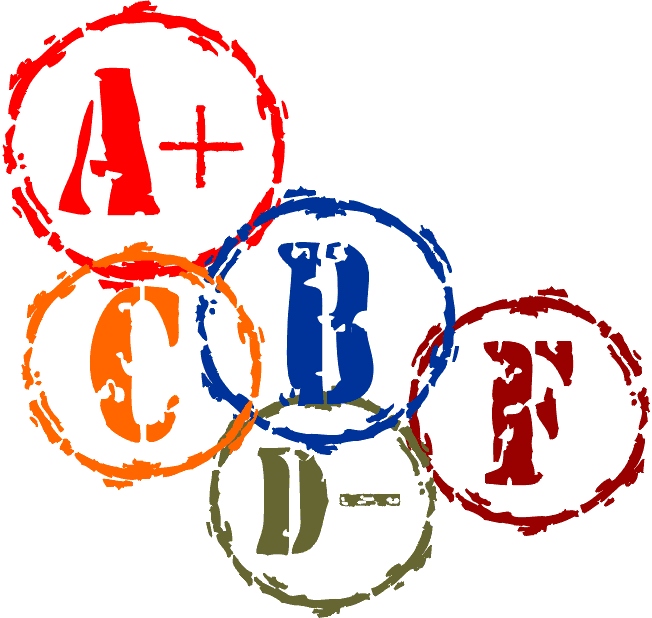
I can remember asking a very intelligent student of mine a few questions about grades. Here is how it went:
Me: What would you consider to be a good grade?
Student: I have to get honors.
Me: Why do you have to?
Student: My parents expect me too.
Me: What happens when you get honors?
Student: I get money, and I stop.
Me: You stop what?
Student: Learning. Why would I need to learn more if I have honors.
Me: *thud* (that was the sound of my jaw dropping)
It's sad but true. Grades make kids think of learning in a linear fashion. (I've written about this before when I discussed asymptotes). And because they come to see learning as linear, they start to see education as a destination rather than a journey.
This is no small problem. Just look at what she said. She said that she stopped once she achieved her goal. She said she stops... *thud* (that was my jaw again)
I don't know about you, but if we do anything to discourage learning in any way, we have got to stop doing it. Dont' we?
This student, like so many others, didn't even need this fabricated incentive to learn. Rather than encouraging her to learn more, grades were actually artifically sabotaging her.
I stopped giving grades 5 years ago. When will you?
For more on abolishing grading, check out this page.
Wednesday, March 3, 2010
Praising Effort vs Ability

Carol Dweck is widely regarded as one of the world’s leading researchers in the fields of personality, social psychology and developmental psychology. Her research has differentiated between two kinds of praise. Praising the child for their intelligence – “You must be smart at this” and praising the child for their effort – “You must have worked really hard”. In a study that Dweck conducted multiple times (because the results were almost unbelievable) two groups of students were given a task. One group was praised for their ability while the other was praised for their effort. Before being given any praise, the two groups were indistinguishable; however, after the praise was applied the two groups began to differ. When given another opportunity, the students who were praised for their ability seemed intimidated by a challenging task and overwhelmingly preferred an easier second task; whereas ninety percent of the students who were praised for their effort wanted the challenging, more difficult second task so they could advance their learning. “When we praise children for their intelligence,” Dweck explained, “we tell them that’s the name of the game: look smart, don’t risk making mistakes.”
When given a third opportunity to perform a challenging task, the two groups showed some similarities and some differences. Both groups performed poorly at the challenging task, but their response to this setback differed greatly. The praised-for-effort group proved to be far more resilient in their attitude towards the challenge. Despite their lack of success and frustration with the task, they proved to be far more willing to try different solutions and give it a go. However, Dweck explained “But the group praised for its intelligence hated the harder test. They took it as proof they weren’t smart.”
As if the results from this experiment weren’t enough to make us question our use of praise, Dweck had both groups do a task similar to the difficulty level of the initial test. The praised-for-effort group showed a 30 percent improvement, while the praised-for-ability group’s score actually plunged 20 percent. When both groups were asked to share their scores with others, “almost 40 percent of the ability-praised students lied about their scores. And always in one direction.” Dweck concluded, “What’s so alarming is that we took ordinary children and made them into liars, simply by telling them they were smart.”
Dweck’s book Mindset goes on to show the difference between students who have a growth mindset versus those who are stuck in a fixed mindset. People who have a growth mindset see their intelligence as something that is always growing slowly over time, and mistakes are opportunities to grow one’s intelligence. However, people who have a fixed mindset see their intelligence as a prefixed quantity and if you are smart enough, mistakes and failures just shouldn’t happen.
For an extensive look at this research read Mindset: The New Psychology of Success by Carol Dweck
This is an excerpt from a larger article I wrote:

Tuesday, March 2, 2010
Morning Joe's Ignorance
I am disgusted by the trash people call Morning Joe. The shear amount of ignorant, uninformed opinions that are being sold as truths here are nothing short of criminal.
Here is a list of essential reading you need to do in order to understand how upset I am about these people's ignorance to progressive educational reform.
The Folly of Merit Pay
Why Not Fire All the Teachers?
Progressive Education
Why Test Scores do not measure Educational Quality
This is yet another example of how people OUTSIDE of the classroom profess to know what should go on INSIDE the classroom.
This is the kind of ignorance that is threatening public education, and they don't even know it.
It makes me sad.
Here is a list of essential reading you need to do in order to understand how upset I am about these people's ignorance to progressive educational reform.
The Folly of Merit Pay
Why Not Fire All the Teachers?
Progressive Education
Why Test Scores do not measure Educational Quality
This is yet another example of how people OUTSIDE of the classroom profess to know what should go on INSIDE the classroom.
This is the kind of ignorance that is threatening public education, and they don't even know it.
It makes me sad.
Winning vs learning
In sports, at what age should winning be considered more important than player development?
Monday, March 1, 2010
Teacher's Intent

Every year I get a couple student teachers from the local college. They are third or fourth year university students who are learning to become teachers (Bachelor of Education typicall takes four years of university in Alberta - sometimes five). And every year I have to convince them that everything they have been told about lesson planning was maybe a little bit of a lie.
Let me explain by using an excerpt from the book Made to Stick: Why Some Ideas Survive and Others Die by Chip and Dan Heath.
Every move an Army soldier makes is preceded by a staggering amount of planning, which can be traced to an original order from the president of the United States. The president order the Joint Chiefs of Staff to accomplish an objective, and the Joint Chiefs set the parameters of the operation. Then the orders and plans begin to cascade downward - from generals to colonels to captains.
The plans are quite thorough, specifying the "scheme of maneuver" and the "concept of fires" - what each unit will do , which equipment it will use, how it will replace munitions, and so on. The orders snowball until they accumulate enough specificity to guide the actions of individual foot soldiers at particular moments of time.
The Army invests enormous energy in its planning, and its processes have been refined over many years. The system is a marvel of communication. There's just one drawback: The plans often turn out to be useless.
"The trite expression we always use is No plan survives contact with the enemy," says Colonel tom Kolditz, the head of behavioral sciences division at West Point. "You may start off trying to fight your plan, but the enemy gets a vote. Unpredictable things happen - the weather changes, a key asset is destroyed, the enemy responds in a way you don't expect. Many armies fail because they put all their emphasis into creating a plan that becomes useless ten minutes into battle."
The Army's challenge is akin to writing instructions for a friend to play chess on your behalf. You know a lot about the rules of the game, an you may know a lot about your friend and the opponent. But if you try to write move-by-move instrucitons you'll fail. You can't possibly foresee more than a few moves. The first time the opponent makes a surprise move, your friend will have to throw out your carefully designed plans and rely on her instincts.
Colonel Kolditz says, "Over time we've come to understand more and more about what makes people successful in complex organizations." he believes that plans are useful, in the sense that they are proof that planning has taken place. The planning process forces people to think through the right issues. But as for the plans themselves, Kolditz says, "They just don't work on the battlefield." So, in teh 1980s the Army adapted its planning process, inventing a concept called Commander's Intent (CI).
CI is a crisp, plain-talk statement that appears at the top of every order, specifying the plan's goal, the desired end-state of an operation. At high levels of the Army, the CI may be relatively abstract: "Break teh will of the enemy in the Southeast region."
...The CI never specifies so much detail that it risks being rendered obsolete by unpredictable events. "You can lose the ability to execute the original plan, but you never lose the responsibility of executing the intent," says Kolditz.
No plan survives the enemy. Even those who have no connection to the military must find a lot of truth in that statement. For teachers, no lesson plan or curriculum survives contact with students.
Lesson planning is stressed a lot in our teacher education programs in Alberta, but it shouldn't be that important. A teacher who plans their entire lesson from start to finish without bringing the students in on the planning is no less foolish than the bride who plans her entire wedding, honeymoon and life without finding a husband to share it with.
The same can be said of inflexible and top-down prescribed curriculums. Good teachers know that no curriculum survives first contact with the students. That is why curriculum should be focused less on a 'bunch o' facts' and more on teaching the cognitive, thinking and collaborative skills that children will need.
If we are going to continue to seriously pursue national, state or provincial standards then we need to seriously look at keeping those standards as vague as possible.
Alfie Kohn summarizes this standards movement nicely in Beware of the Standards, Not Just the Tests:
Considerable research has demonstrated the importance of making sure students are actively involved in designing their own learning, invited to play a role in formulating questions, creating projects, and so on. But the more comprehensive and detailed a list of standards, the more students (and even teachers) are excluded from this process, the more alienated they tend to become, and the more teaching becomes a race to cover a huge amount of material. Thus, meeting these kinds of standards may actually have the effect of dumbing down classrooms. As Howard Gardner and his colleagues wisely observed, "The greatest enemy of understanding is 'coverage.'"
Just as standards and curriculum should be kept vague, so should lesson planning. The vagueness is necessary so to allow teachers and students to personalize their learning to suit their own personal needs.
Susan Ohanian's book One Size Fits Few and Peter Sack's book Standardized Minds are fascinating reads on why standardization is doing more harm than good.
Made to Stick shows how important it is to keep planning to a simple primary objective, but they also show how training your personal properly and then trusting them to understand the objective is at the heart of good planning.
Like the Commander's Intent that the Army created, we might be better off creating a Teacher's Intent that keeps the primary objective of school focused on one very focused, primary objective - that all children would have the desire to go on learning. An interesting model of this Teacher's Intent might be found in UNESCO's Four Pillars of Education.
But none of this works if teachers are distrusted. If we continue to try and 'teacher-proof' education with more top-down prescribed standards and standardization, we will never be able to properly provide our children with the education they deserve.
Subscribe to:
Posts (Atom)